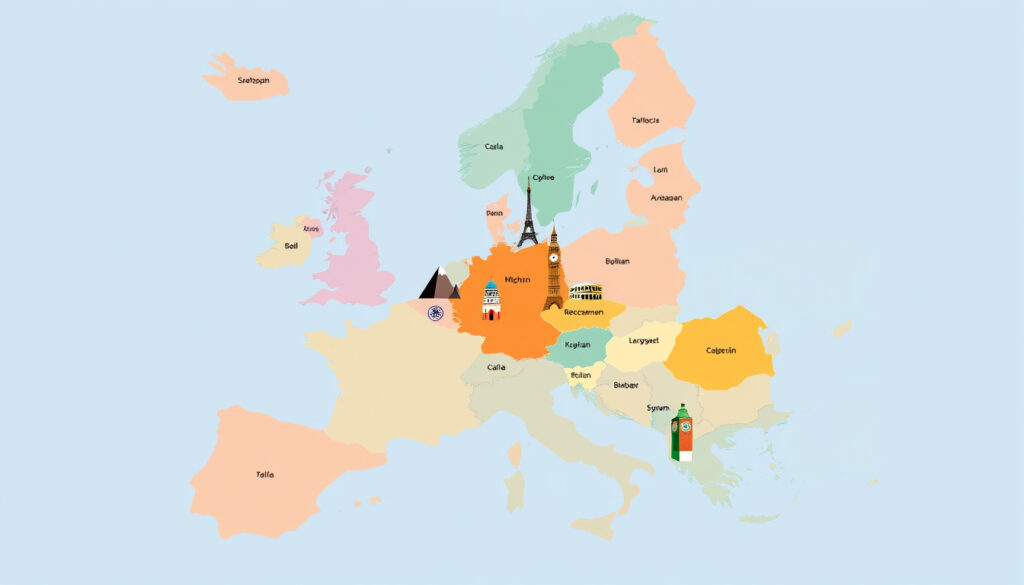
Europe Countries and Regions: 50 Nations and 4 UN Subregions
Ever wondered why lists of European countries never seem to agree? Depending on who you ask, there are 44, 47, 50, or even 51 countries in Europe. That variation stems from different definitions — the UN geoscheme, cultural traditions, and the inclusion of transcontinental states. This guide sorts through the numbers, the regions, and the key economies that define the continent.
Sovereign states in Europe: 50 · UN geoscheme regions: 4 · EU member countries: 27 · Big Four economies: France, Germany, Italy, UK
Quick snapshot
- Europe has 50 sovereign states by conventional definition (Worldometer (population data provider))
- UN Geoscheme divides Europe into 4 subregions (WorldAtlas (geography publisher))
- Western Europe Big Four: France, Germany, Italy, United Kingdom (European Union (official institutional site))
- Inclusion of transcontinental countries varies by source (Wikipedia (community-edited encyclopedia))
- Whether Kosovo is counted as a sovereign state (Wikipedia (international recognition article))
- Exact number of “51 countries” depends on recognized states (WorldAtlas (geography publisher))
- UN Geoscheme classification created by UNSD based on M49 coding (UNSD M49 (UN statistical authority))
- Geoscheme regularly updated; latest revision in 2024 (UNSD (statistical methodology))
- Continued debate over transcontinental Turkey’s inclusion (WorldAtlas (geography publisher))
- Potential EU enlargement could shift regional groupings (European Union (official institutional site))
The table below shows six key metrics at a glance: the conventional count, UN membership, EU size, and extremes of area.
| Label | Value |
|---|---|
| Total sovereign states | 50 (conventional definition) (Worldometer) |
| UN member states in Europe | 44 (UNSD M49) |
| European Union members | 27 (European Union) |
| Largest country (area) | Russia (partially in Europe) (WorldAtlas) |
| Smallest country | Vatican City (Worldometer) |
The pattern: the higher the count, the more inclusive the geographic definition. The UN’s statistical definition is the most conservative.
How many countries are in Europe?
Conventional count vs UN membership
- By conventional definition, Europe has 50 sovereign states (Worldometer (population data provider)).
- However, only 44 of those are UN member states according to the UNSD M49 classification (UNSD (UN statistical authority)).
- The difference arises because some countries are transcontinental — Russia and Turkey straddle Europe and Asia (WorldAtlas (geography publisher)).
The implication: the “true” number depends entirely on whether you count by geography, politics, or statistical convenience. No single answer is wrong — but each serves a different purpose.
Sources that list 44, 47, 50, or 51 countries
- 44 countries — UN member states only, used by the United Nations (UNSD M49).
- 47 countries — includes some partially recognised states like Kosovo (Worldometer).
- 50 countries — mainstream geographic consensus, used by the WorldAtlas and Worldometer.
- 51 countries — adds transcontinental Turkey and Russia, plus sometimes Kazakhstan (Wikipedia (list of transcontinental countries)).
What are the 4 types of Europe?
UN Geoscheme: Northern, Southern, Western, Eastern Europe
The United Nations geoscheme, created by the UN Statistics Division, divides Europe into four subregions for statistical convenience (UNSD M49).
- Northern Europe (10 countries) — includes Scandinavia, the Baltics, and the UK/Ireland (WorldAtlas).
- Western Europe (9 countries) — Benelux, France, Monaco, and Germany (WorldAtlas).
- Southern Europe (15 countries) — Mediterranean states including Italy, Spain, Greece, and the western Balkans (WorldAtlas).
- Eastern Europe (the largest subregion) — Russia, Ukraine, Belarus, Moldova, and the Caucasus countries (WorldAtlas).
The catch: the UN geoscheme explicitly states its groupings are “for statistical convenience and do not imply political or other affiliation” (EMIW (European statistical coordinating body)).
Alternative regional groupings
- Many geographers and cultural historians prefer a five- or six-region model that includes Central Europe (WorldAtlas).
- The EU itself does not use the UN geoscheme; it groups countries by accession waves and political geography (European Union).
- Other classifications come from organisations like the Council of Europe (46 members) or EuroVoc (the EU’s thesaurus) (Wikipedia (Council of Europe article)).
Why this matters: travellers, students, and researchers often encounter conflicting region labels. Knowing the source of the classification prevents confusion.
What are the 5 regions of Europe?
Five-region model: Northern, Western, Central, Eastern, Southern
Adding Central Europe creates a more culturally intuitive map, though it has no official UN status (WorldAtlas).
- Northern Europe — Norway, Sweden, Finland, Denmark, Iceland, the Baltics, UK, Ireland (WorldAtlas).
- Western Europe — France, Benelux, Germany, Switzerland, Austria, Liechtenstein (WorldAtlas).
- Central Europe — Poland, Czech Republic, Slovakia, Hungary, Slovenia (WorldAtlas).
- Eastern Europe — Russia, Ukraine, Belarus, Moldova, Romania, Bulgaria (sometimes included in Southeast Europe) (WorldAtlas).
- Southern Europe — Italy, Spain, Portugal, Greece, Malta, Cyprus, the Balkans (WorldAtlas).
The trade-off: the five-region model is more useful for cultural and historical contexts, but it is not standardised — different sources shuffle countries between subregions.
Variations by historical/cultural grouping
- The CIA World Factbook groups Europe into seven regions, splitting Scandinavia from the Baltics (Wikipedia (CIA World Factbook)).
- Some cultural maps highlight Southeast Europe (the Balkans) as a distinct subregion separate from Southern Europe (WorldAtlas).
- Historical definitions often include Central and Eastern Europe as a single bloc from the Cold War era (Wikipedia (Central and Eastern Europe article)).
The pattern: there is no single “correct” regional map. The best choice depends on whether you’re analysing climate, language, economics, or politics.
Who are the big four in Europe?
Big Four (Western Europe): France, Germany, Italy, United Kingdom
The “Big Four” Western European economies — France, Germany, Italy, and the United Kingdom — have long dominated the continent’s economic output (European Union).
- Together they account for roughly 65% of EU GDP (pre-Brexit) and remain the largest national economies in Europe (Eurostat (EU statistical office)).
- The term “Big Four” is used in business and political contexts to refer to these four countries’ outsized influence in EU decision-making (Wikipedia (Big Four article)).
The implication: the Big Four effectively steer European economic policy, though the UK’s departure from the EU has shifted the dynamic.
EU three: France, Germany, Italy
Post-Brexit, the “EU three” — France, Germany, Italy — are the largest economies within the European Union (European Union).
- These three countries alone represent over 50% of the EU’s total GDP (Eurostat).
- Their votes and positions heavily influence EU trade, climate, and migration policy (Wikipedia (EU three article)).
What this means: any major EU initiative needs support from at least two of these three to pass — they are the bloc’s de facto leadership.
Big three countries by area and population
- By area: Russia (European part ~3.9 million km²), Ukraine (603,628 km²), France (551,695 km²) (WorldAtlas).
- By population: Russia (European part ~110 million), Germany (~83 million), UK (~67 million) (Worldometer).
The trade-off: Russia dominates area but its European population is spread; Germany punches above its size economically.
What are the 51 countries in Europe?
List of Europe’s 51 countries with transcontinental states
The “51 countries” count includes transcontinental Turkey, Russia, and Kazakhstan (sometimes also Azerbaijan and Georgia) (WorldAtlas).
- Turkey — 97% in Asia, 3% in Europe, but politically European enough to be a candidate for EU membership (European Union).
- Russia — 23% of its landmass is in Europe, but that portion holds 77% of its population (WorldAtlas).
- Kazakhstan — a small slice west of the Ural River is geographically in Europe (Wikipedia (Kazakhstan article)).
The pattern: including any transcontinental state raises the count. The 51 figure is the most generous geographic list, used by some encyclopedias.
Alphabetical order of all European nations
- Albania, Andorra, Austria, Belarus, Belgium, Bosnia and Herzegovina, Bulgaria, Croatia, Cyprus, Czech Republic, Denmark, Estonia, Finland, France, Germany, Greece, Hungary, Iceland, Ireland, Italy, Kosovo, Latvia, Liechtenstein, Lithuania, Luxembourg, Malta, Moldova, Monaco, Montenegro, Netherlands, North Macedonia, Norway, Poland, Portugal, Romania, Russia, San Marino, Serbia, Slovakia, Slovenia, Spain, Sweden, Switzerland, Turkey, Ukraine, United Kingdom, Vatican City (Worldometer).
The takeaway: this 48-item list excludes some transcontinental additions; the 50-51 lists add Kazakhstan, transcontinental Turkey, and sometimes Georgia.
What we know vs what’s still unclear
Confirmed facts
- Europe has 50 sovereign states by conventional definition.
- UN Geoscheme divides Europe into 4 subregions.
- Western Europe Big Four: France, Germany, Italy, United Kingdom.
What’s still unclear
- Inclusion of transcontinental countries like Turkey, Russia, and Kazakhstan varies by source.
- Whether Kosovo is counted as a sovereign state (recognised by some UN members).
- Exact number of “51 countries” based on different recognised states.
Voices on regional classification
“The assignment of countries or areas to UN geoscheme groupings is for statistical convenience and does not imply political or other affiliation.”
— United Nations, from the EMIW appendix (EMIW (European statistical coordinating body))
“Europe is divided into 50 sovereign states by the most widely used geographic classifications, though the UN member count is 44.”
— Worldometer, from its country count methodology (Worldometer (population data provider))
“The European Union is a unique economic and political union of 27 countries.”
— European Union, official website (European Union (official institutional site))
For a European planner or student deciding which countries to include in a report, the choice is clear: use the UN geoscheme (44 nations) for statistical consistency, or the conventional list (50 nations) for general reference. Avoiding the ambiguity is impossible — but understanding it is essential.
Frequently asked questions
What is the largest country in Europe by area?
Russia, though only its European portion (roughly 3.9 million km²) is considered part of Europe. Ukraine is the second largest entirely European country (WorldAtlas).
What is the smallest country in Europe?
Vatican City, with an area of 0.44 km² and a population of around 800 (Worldometer).
Which countries are in the European Union?
The EU has 27 member states: Austria, Belgium, Bulgaria, Croatia, Cyprus, Czech Republic, Denmark, Estonia, Finland, France, Germany, Greece, Hungary, Ireland, Italy, Latvia, Lithuania, Luxembourg, Malta, Netherlands, Poland, Portugal, Romania, Slovakia, Slovenia, Spain, Sweden (European Union).
Is Turkey considered part of Europe?
Geographically, only 3% of Turkey’s land lies in Europe. However, it is culturally and politically associated with Europe, and it is a candidate for EU membership (WorldAtlas).
How many countries in Europe are not in the EU?
About 23 European countries are not EU members, including the UK, Norway, Switzerland, Russia, Ukraine, and the Balkan states that are either non-members or candidates (European Union).
What are the Nordic countries?
The Nordic countries are Denmark, Finland, Iceland, Norway, and Sweden, plus their associated territories (Greenland, Åland, Faroe Islands). They are part of the Northern Europe subregion (WorldAtlas).
Which European country has the largest population?
Germany has the largest population of any fully European country (about 83 million). Russia’s European population is larger (~110 million) but Russia is transcontinental (Worldometer).
More related posts
 How to Get Rid of a Cold Sore in 24 Hours – Proven Relief Methods
 Scotland v New Zealand – 2026 Tickets Date History
 Spiderman Across the Spider Verse – Cast, Plot and Sequel Guide
 What Is the Capital of Canada? Ottawa vs Toronto Explained
 How to Help Constipation: Fast Relief and Home Remedies
 Isle of Skye Weather: Best Month, Rainfall, Midges & Storm Amy Guide
 Tube Strike London 2025 – Dates, Lines and Alternatives
