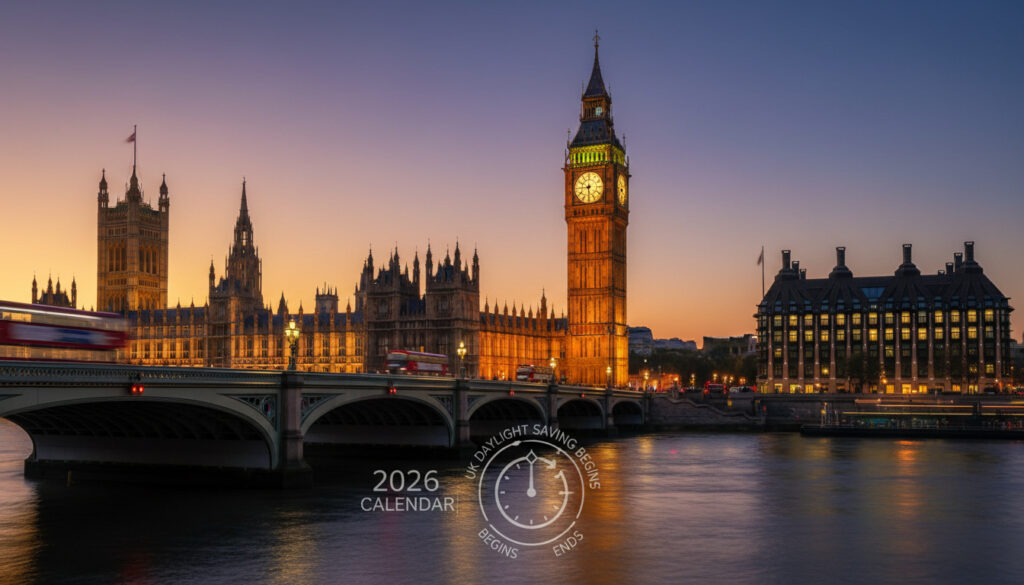
When Does the Time Change – UK 2026 Dates Explained
Twice each year, the UK shifts between Greenwich Mean Time and British Summer Time, adjusting clocks to capture extra daylight during the warmer months. The change happens at specific hours mandated by statute, affecting everything from railway timetables to smartphone settings across England, Scotland, Wales and Northern Ireland.
In , the transition to summer time occurs on Sunday , when clocks advance at GMT. The return to winter time follows on Sunday , when clocks retreat at BST. These dates follow the European Union pattern retained by the UK following Brexit.
Understanding the precise mechanics of these shifts helps prevent missed appointments and disrupted schedules, particularly for those working across time zones or managing automated systems.
When do the clocks change in the UK?
Last Sunday in March
Last Sunday in October
01:00 GMT / 02:00 BST
29 March / 25 October
The UK shifts between time zones on fixed seasonal dates determined by the Summer Time Order 2002. Clocks advance in spring to mark the start of British Summer Time (BST), then retreat in autumn to return to Greenwich Mean Time (GMT). This pattern creates approximately seven months of extended evening daylight, concluding when winter approaches.
Key facts to remember
- Clocks always move forward on the final Sunday of March
- The autumn change occurs on the last Sunday of October
- Big Ben and roughly 2,000 clocks at Westminster require manual adjustment by horologists
- Digital devices typically update automatically via network time protocols
- The mnemonic “Spring forward, fall back” indicates the directional shift
- BST operates at UTC+01:00, while GMT aligns with UTC+00:00
Confirmed dates through 2028
| Year | Clocks Forward | Clocks Back |
|---|---|---|
| 2025 | 30 March | 26 October |
| 2026 | 29 March | 25 October |
| 2027 | 28 March | 31 October |
| 2028 | 26 March | 29 October |
Source: GOV.UK
When do the clocks go forward?
The spring transition occurs at GMT on the final Sunday of March. At this moment, timepieces skip ahead to BST, effectively removing one hour from the early morning. This adjustment shifts daylight from the morning into the evening, providing extended sunlight during waking hours throughout the summer months.
What time do clocks change?
The specific hour of transition is mandated by legislation. Clocks shift precisely at Greenwich Mean Time, advancing to British Summer Time. This timing minimizes disruption to railway schedules and early morning transport operations, occurring when most commercial activity remains dormant.
The change happens instantaneously at GMT. Devices connected to mobile networks typically adjust automatically, while analogue clocks require manual advancement to .
Why advance the clocks?
The practice intends to align waking hours with available daylight, reducing artificial lighting consumption during the evenings. This concept originated with William Willett’s 1907 pamphlet The Waste of Daylight, which argued that morning sunlight went unused while people slept. Supporters including Winston Churchill and Arthur Conan Doyle championed the idea, though implementation waited until the First World War.
During the Second World War, the UK temporarily adopted Double Summer Time, moving clocks two hours ahead of GMT during the summer months to support agricultural production and reduce blackout requirements. This exceptional measure lasted from 1941 until 1947.
When do the clocks go back in the UK?
The autumn reversal occurs at BST on the last Sunday of October, returning clocks to GMT. This shift marks the end of British Summer Time and restores Greenwich Mean Time for the winter period. The change grants an extra hour of sleep but reduces evening daylight, prompting earlier darkness throughout the winter months.
October transition mechanics
Unlike the March advance, the October change provides a repeated hour. Devices displaying BST revert to GMT, meaning the 60-minute period occurs twice. This requires careful attention for time-stamped systems, medical equipment, and transport logs to ensure accurate chronological records.
Impact on daily routines
The return to GMT produces earlier sunrises but earlier sunsets. For those monitoring transport disruptions, the shift may affect connection times and operating hours around the Tube Strike London 2025 Dates. The alteration typically causes temporary disruption to sleep patterns as the body adjusts to the new light-dark cycle.
What are the clock change dates for 2026?
For 2026 specifically, British Summer Time begins on Sunday and concludes on Sunday . These dates represent the last Sundays of their respective months, adhering to the European Union directive retained in UK law following Brexit. Greenwich Mean Time confirms these dates align with the official calendar last updated in November 2025.
The 2026 forward transition occurs on at GMT, while the backward shift falls on at BST. These dates apply uniformly across England, Scotland, Wales and Northern Ireland.
Sporting events scheduled during these transition periods require particular attention. Fans planning to attend the Scotland v New Zealand 2026 Date should verify whether the fixture falls within BST or GMT to ensure correct arrival times.
While smartphones update automatically, approximately 2,000 clocks at the Palace of Westminster including Big Ben require manual adjustment by specialists. Household analogue clocks and timers need individual attention to avoid scheduling errors.
Regional consistency
The 2026 changes affect the entire United Kingdom simultaneously. No devolved administration maintains separate time legislation, ensuring synchronized transitions across all borders. This uniformity supports cross-border transport and communication networks.
How has the clock change schedule evolved?
The current system represents over a century of legislative refinement and wartime adjustment.
- 1907: William Willett publishes The Waste of Daylight, proposing daylight saving to utilize morning sunlight. Source: Visit London
- 1916: The Summer Time Act implements the first British Summer Time period, beginning 21 May and ending 1 October. Source: Wikipedia
- 1941-1947: Double Summer Time (GMT+2) operates during the Second World War to maximize agricultural productivity. Source: Calendarr
- 1996: EU Directive 2000/84/EC standardizes clock changes across member states to the last Sunday of March and October.
- 2002: The UK enacts the Summer Time Order, retaining the EU pattern post-Brexit. Source: Wikipedia
- Present: The UK maintains alignment with European daylight saving practices through statutory instrument.
What is established and what remains uncertain?
Established Facts
- Changes occur at 01:00 GMT (forward) and 02:00 BST (back)
- Last Sunday of March and October formula applies indefinitely
- All UK nations follow identical time legislation
- 2026 dates are confirmed as 29 March and 25 October
- BST duration is approximately seven months annually
Uncertain Elements
- Long-term political commitment to daylight saving remains debated
- Potential future divergence from EU time standards is unconfirmed
- Specific impact on circadian health varies by individual
- Legislative changes would require new statutory instruments
Where did British Summer Time originate?
The concept emerged from William Willett’s persistent advocacy for daylight utilization. His 1907 pamphlet calculated the economic and health benefits of shifting working hours to coincide with natural light, estimating substantial savings in artificial lighting costs. Despite support from prominent political figures including Winston Churchill and author Arthur Conan Doyle, the proposal faced initial rejection from Parliament.
The First World War precipitated immediate adoption. Fuel shortages and the need to maximize productive daylight hours led to the Summer Time Act 1916. The legislation established the principle, though contemporary dates differed from current practice. The wartime emergency measure proved sufficiently popular to survive peacetime, evolving through various experimental periods including the extended double summer time of the 1940s.
Contemporary arrangements derive from EU Directive 2000/84/EC, standardized in 1996 to facilitate cross-border commerce. The UK retained these provisions through the Summer Time Order 2002, maintaining synchronization with European markets regardless of Brexit outcomes.
What do official authorities say?
Primary authority rests with GOV.UK, which provides the definitive mechanism for clock changes and downloadable calendar files. The National Physical Laboratory maintains atomic clock standards that underpin these transitions, ensuring precision to fractions of a second.
Clocks go forward 1 hour at 1:00am (UK time) on the last Sunday in March and back 1 hour at 2:00am (UK time) on the last Sunday in October.
— GOV.UK Official Guidance
The National Today cultural observance database corroborates these dates, noting the widespread mnemonic “Spring forward, fall back” used across English-speaking regions to remember the directional shift.
When does the time change next?
The UK will next adjust clocks on Sunday , advancing from GMT to BST. The subsequent change occurs on Sunday , reverting from BST to GMT. These transitions follow the established statutory pattern affecting all four UK nations simultaneously. For travellers monitoring Tube Strike London 2025 Dates or planning around the Scotland v New Zealand 2026 Date, verifying time zone status remains essential for punctual attendance.
Frequently asked questions
Do the clocks go forward or back in October?
Clocks go back in October. On the last Sunday of the month at 02:00 BST, timepieces revert to 01:00 GMT, marking the return to Greenwich Mean Time.
What is daylight saving time?
Daylight saving time refers to the practice of advancing clocks during warmer months to extend evening daylight. In the UK, this period is called British Summer Time (BST), operating from March to October.
Does Scotland follow different clock changes?
No. Scotland follows the same time changes as England, Wales and Northern Ireland. All UK nations transition simultaneously according to the Summer Time Order 2002.
Why do clocks change at 1am and 2am?
These times minimize disruption to transport and business operations. The early hour ensures most commercial and public service activities remain unaffected while networks synchronize.
Will the UK abolish clock changes?
No legislation has been enacted to abolish clock changes. The UK currently maintains the 2002 Order, with no announced plans to alter the system despite periodic debates in Parliament.
More related posts
 Early Signs of Pregnancy Before Missed Period: 10 Symptoms
 UK 2025 Pensioners TV License – Free Eligibility Rules
 One 4 All Card – Balance Check, Stores and Expiry Guide
 Kids Activities Near Me in Ireland: Free Family Fun
 Dune 3 Release Date – Confirmed December 18, 2026
 BBC Sport Cricket Scores: Live Updates and Fixtures
 7ft Pre-Lit Christmas Tree – Best UK Picks and Guides
 Cast of Bones (TV Series) – Full Cast Seasons Timeline
