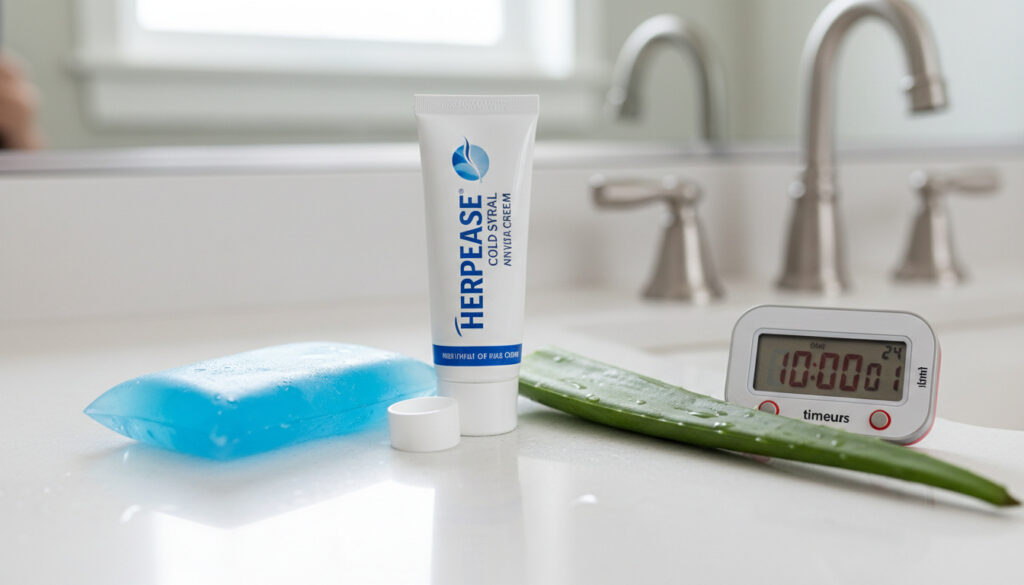
How to Get Rid of a Cold Sore in 24 Hours – Proven Relief Methods
The search for rapid cold sore relief leads many to wonder whether complete healing within a single day is possible. While the herpes simplex virus type 1 (HSV-1) that causes these facial lesions cannot be eradicated in 24 hours, specific interventions initiated at the first sign of symptoms can significantly reduce discomfort and potentially shorten the outbreak duration.
Medical consensus indicates that antiviral medications and targeted home remedies work best when applied during the initial tingling phase. Understanding the biological constraints of viral infection while maximizing early treatment options offers the most realistic path to rapid symptom management.
How to Get Rid of a Cold Sore in 24 Hours at Home
Fastest OTC Response
Antiviral creams containing acyclovir or penciclovir, or docosanol (Abreva), work most effectively when applied within the first 48 hours of symptom onset.
Home Hacks
Ice application and overnight salt compresses may reduce swelling and discomfort, though they do not eliminate the virus.
Prevention Focus
Identifying and avoiding personal triggers—such as stress, sun exposure, or illness—remains critical for long-term management.
Reality Check
Complete healing typically requires 7 to 10 days. Twenty-four-hour protocols target symptom relief and outbreak suppression rather than instant cure.
- Prescription antivirals like valacyclovir can reduce healing time by one to two days when started within 48 hours.
- Over-the-counter docosanol (Abreva) may shorten duration by approximately one day if applied at the first tingle.
- Ice packs applied for 10-15 minutes during the first 48 hours reduce swelling and numb pain.
- Lysine supplementation (1,000 mg) showed healing in five days for 85% of study participants versus 6-15 days without.
- Cold sores remain contagious from the initial tingling sensation until the scab fully heals.
- There is no cure for HSV-1 infection; treatments manage symptoms and speed healing.
- Propolis ointment (3%) demonstrated mean healing times of 6.24 days compared to 9.77 days with placebo.
| Fact | Detail |
|---|---|
| Cause | Herpes simplex virus type 1 (HSV-1) |
| Typical healing time (untreated) | 2 to 4 weeks; commonly 7-10 days for visible healing |
| Optimal treatment window | Within 48 hours of first symptoms |
| Contagious period | From prodrome (tingling) until complete scab resolution |
| Antiviral reduction | 1-2 days faster healing with early oral antivirals |
| Topical antiviral effect | Approximately one day sooner than untreated |
| Lysine therapeutic dose | 1,000 mg oral for active outbreaks; 3,000-6,000 mg daily during episodes |
| Abreva (docosanol) benefit | Shortens healing by about one day if started early |
What Kills Cold Sores Instantly?
The notion of instant cold sore elimination persists in online forums, yet medical evidence contradicts this possibility. No substance currently available can immediately kill the HSV-1 virus or make a cold sore vanish within hours. However, certain interventions can rapidly reduce symptoms and potentially abort early outbreaks before full blister formation.
What Kills Cold Sores Instantly Home Remedies
Home remedies claiming instant destruction of cold sores typically address surface symptoms rather than viral load. Salt applications may dry the lesion overnight, while ice packs provide immediate pain relief by numbing nerve endings. Clinical sources confirm that ice applied for 10-15 minutes several times daily during the first two days effectively reduces swelling.
How to Get Rid of Cold Sores Quick
Rapid resolution requires understanding the viral replication cycle. Once the blister forms, the virus has already completed initial replication. At this stage, treatments shift from prevention to acceleration. Topical antivirals like acyclovir or penciclovir cream, when applied every 2-3 hours during daytime for five days, can advance healing by approximately one day compared to no treatment.
No home remedy or over-the-counter product can completely eliminate a cold sore within 24 hours. Claims of instant cures lack clinical validation. The virus remains latent in nerve tissue and cannot be flushed from the body through topical applications.
Cold Sore Medicine and Over-the-Counter Options
Access to appropriate medications varies by healthcare system. While M&S Opticians NHS Eye Tests illustrate how UK residents navigate specific health services, cold sore treatments remain widely available through pharmacies and general practitioners nationwide.
Prescription Antiviral Medications
Oral antiviral medications represent the most aggressive pharmaceutical approach to rapid healing. Valacyclovir (Valtrex), acyclovir (Zovirax), and famciclovir (Famvir) constitute the primary prescription options. When initiated within the first 24-48 hours of symptom onset, these medications can cut healing time by one to two days, reduce pain severity, and prevent the sore from enlarging.
For individuals experiencing frequent outbreaks, healthcare providers may recommend daily suppressive therapy. Chronic antiviral regimens reduce both the frequency and severity of episodes, though this requires medical supervision.
Over-the-Counter Topical Treatments
Abreva (docosanol) stands as the only FDA-approved non-prescription medication proven to shorten cold sore duration. Applied at the first tingle, it can reduce healing time by approximately one day. For optimal results, users must apply it multiple times daily throughout the outbreak.
Other OTC options focus on symptomatic relief rather than healing acceleration. Creams containing lidocaine or benzocaine provide topical anesthesia, while petroleum jelly keeps the lesion moist to prevent cracking. Lip balms with sunscreen protect healing tissue from ultraviolet radiation that could worsen the sore.
Can You Kiss Someone or Swim with a Cold Sore?
Can You Kiss Someone with a Cold Sore
Direct oral contact during an active outbreak poses significant transmission risk. Medical authorities classify cold sores as highly contagious from the initial tingling phase through complete scabbing. The virus spreads through saliva and skin contact, potentially infecting partners with HSV-1 or, rarely, causing genital herpes through oral-genital transmission.
The HSV-1 virus sheds most actively during the weeping stage when blisters rupture. However, asymptomatic shedding can occur even without visible sores, though kissing during active lesions presents the highest transmission probability.
Can You Swim with a Cold Sore
Swimming pools and natural bodies of water present complex scenarios for cold sore management. While chlorinated water may theoretically disinfect the lesion, the moisture can soften the scab and delay healing. More critically, shared towels and direct water contact create transmission vectors to others. Dermatologists generally recommend avoiding swimming during the active blister phase to prevent both viral spread and secondary bacterial infection.
Beyond swimming and kissing, avoid sharing lip balm, utensils, or towels during outbreaks. The virus can spread to other body parts, including the eyes and genitals, making hand hygiene essential after touching the affected area. Keep the cold sore clean with gentle soap and water to prevent bacterial infection.
How Long Does Each Cold Sore Stage Last?
Understanding the chronological progression of HSV-1 outbreaks helps set realistic expectations for treatment timelines. While individual experiences vary, most cold sores follow a predictable five-phase cycle.
- Prodrome (Day 1): The tingling, itching, or burning sensation indicates viral reactivation. This window—lasting hours to a day—offers the optimal intervention point for antiviral medication.
- Blister Formation (Hours later): Small, fluid-filled vesicles emerge at the site, typically within 12-24 hours of prodrome onset.
- Weeping (Day 2): Blisters rupture, releasing clear fluid containing millions of viral particles. This stage represents peak contagiousness.
- Crusting (Day 3+): The open sore dries into a yellow-brown scab. Healing accelerates as new skin forms beneath.
- Resolution (Day 7-10): The scab falls off naturally, revealing healed skin. Without treatment, cold sores typically clear within 2 to 4 weeks, though most resolve visibly within 7-10 days.
What Can Realistically Be Achieved in 24 Hours?
Separating evidence-based outcomes from marketing claims requires examining what medical interventions can and cannot accomplish within a single day. While complete eradication remains impossible, significant symptom modification proves achievable.
| Established Outcomes | Uncertain or Unproven Claims |
|---|---|
| Ice and cold compresses can reduce swelling and pain within hours | Complete elimination of the cold sore in 24 hours |
| Early antiviral initiation may abort blister formation if caught in prodrome | Instant cures using essential oils or household chemicals |
| Numbing agents provide immediate pain relief | Permanent HSV-1 eradication through home remedies |
| Lysine supplementation may reduce severity when started early | Salt or toothpaste applications “killing” the virus overnight |
| Acyclovir cream started at first tingle reduces healing by ~1 day | Pimple patches healing cold sores (untested for HSV-1) |
Why Does HSV-1 Resist Rapid Elimination?
The biological architecture of herpes simplex virus type 1 explains why 24-hour cures remain elusive. Upon initial infection, typically during childhood, the virus ascends sensory nerve fibers to establish permanent latency in the trigeminal ganglion—a cluster of nerve cells near the ear. During reactivation, viral particles travel back down the nerve to the skin surface, where they replicate within epithelial cells causing the characteristic lesion.
By the time visible symptoms appear, the virus has already completed significant replication and cellular damage. Antiviral medications inhibit further DNA synthesis but cannot reverse cellular changes already enacted. Medical sources emphasize that no current treatment eliminates the latent viral reservoir, ensuring lifelong recurrence potential.
Stress, ultraviolet radiation, hormonal changes, and immunosuppression trigger reactivation by disrupting the delicate balance between viral dormancy and host immune surveillance. Stress reduction techniques such as meditation may reduce outbreak frequency by modulating immune function, though they cannot eliminate existing infections.
What Medical Authorities Say About Rapid Treatment
Major medical institutions consistently emphasize early intervention while managing expectations about cure timelines.
“Antiviral creams can speed up healing if you start using them as soon as you notice symptoms. They may not get rid of the cold sore completely, but they can make it go away sooner and reduce the severity.”
— NHS UK Clinical Guidance
“Treatment works best if you can start it within 48 hours of when the cold sore forms. Antiviral medications are most effective in this window.”
— Cleveland Clinic Medical Review
“There is no cure for cold sores or HSV-1 infection, but antiviral medications can help them heal faster. Early intervention is key.”
— Northwestern Medicine Dermatology
Key Takeaways for Fast Cold Sore Relief
While eliminating a cold sore completely within 24 hours exceeds current medical capabilities, strategic early intervention can significantly reduce discomfort and duration. Initiating antiviral therapy—whether prescription oral medications or OTC docosanol—within the first 48 hours offers the best chance of shortening the outbreak. Supporting these pharmaceutical approaches with ice therapy, lysine supplementation, and proper wound hygiene maximizes symptom control. For those tracking other health optimization methods, examining Ozempic Before and After Results demonstrates how documented timelines matter in medical interventions. Ultimately, understanding that HSV-1 remains incurable but manageable allows for realistic expectations and effective outbreak mitigation.
Frequently Asked Questions
Can you get a cold sore inside your nose?
Yes. HSV-1 can infect nasal mucosa, causing painful lesions inside the nostrils. These internal sores often heal slower than lip lesions due to moisture and limited air exposure. Medical consultation is advisable for intra-nasal outbreaks.
Can you use pimple patches on cold sores?
No clinical evidence supports using hydrocolloid pimple patches for HSV-1 lesions. While patches may absorb fluid, they could trap viral particles against the skin and potentially spread the infection to adjacent areas or fingers during removal.
Is the first cold sore always the worst?
Initial HSV-1 infections often present more severely than subsequent outbreaks. Primary herpetic gingivostomatitis may cause multiple mouth sores, fever, and swollen lymph nodes, while recurrent cold sores typically remain localized and shorter in duration.
Does salt on a cold sore overnight help?
Salt may help dry out the lesion and reduce weeping, but it does not kill the virus or guarantee overnight healing. Applied as a paste, it can reduce moisture and create an environment less favorable for viral replication, though it may also irritate surrounding skin.
Can stress really trigger cold sores?
Psychological stress triggers cortisol release, which can suppress immune function and activate latent HSV-1. Stress management techniques, including deep breathing and meditation, may reduce outbreak frequency in susceptible individuals.
How contagious is a cold sore after it scabs?
Contagiousness decreases significantly once the lesion fully crusts, but viral shedding can continue until the skin completely heals. Avoid kissing and sharing items until the scab naturally falls off and healthy skin appears beneath.
Are cold sores and herpes the same thing?
Cold sores are caused by herpes simplex virus type 1 (HSV-1), a strain of the herpes virus family. While “herpes” technically describes the viral classification, HSV-1 differs from HSV-2, which typically causes genital herpes, though both can infect either location.
More related posts
 Scotland v New Zealand – 2026 Fixture, Scores, Tickets and History
 Are We There Yet – Origin, Movie Facts and Road Trip Tips
 Houses for Sale Nottingham – West Bridgford Prices and Listings
 Day of the Jackal – Cast, Episodes, Streaming Guide
 Bupa Private Health Insurance: 2026 Costs & AXA Comparison
 AQA A Level Biology: Past Papers, Notes & Grade Boundaries
 CW Sellors Administration Collapse – Timeline, Jobs and Customer Advice
 Cash Point Near Me – Guide to Free ATMs and 24/7 Access in UK
