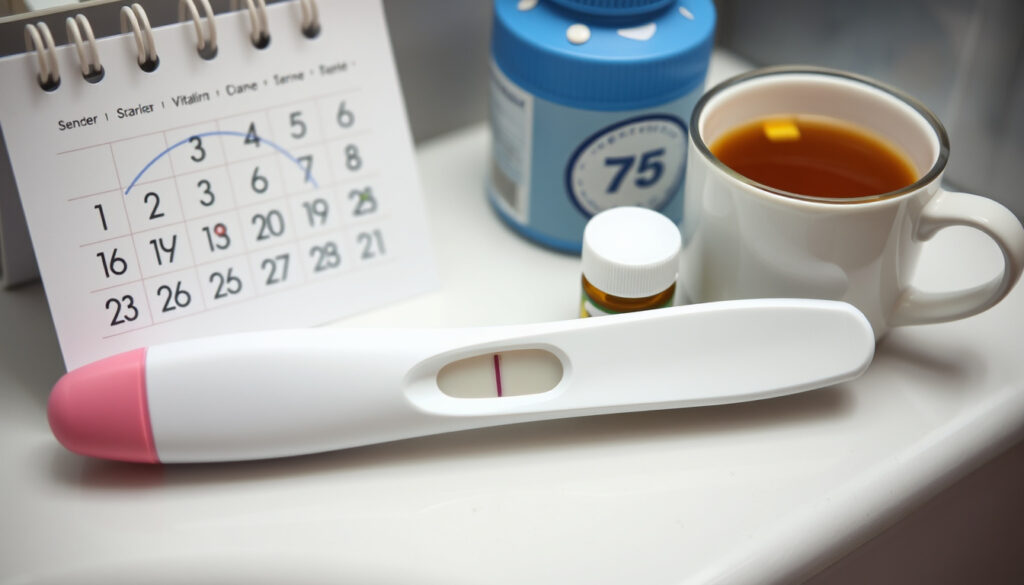
Early Signs of Pregnancy Before Missed Period: 10 Symptoms
Anyone who’s ever stared at a calendar waiting for their period—hoping it’s late for a reason—knows how confusing those days can be. The time before a missed period is often a guessing game between premenstrual syndrome and very early pregnancy.
Implantation timing: 6–12 days after ovulation · HCG detection window: 12–14 days after conception · Most common first symptom: Missed period · Women with symptoms by week 5: ~50% · Implantation bleeding incidence: ~25% of pregnancies
Quick snapshot
- Light spotting 6–12 days after ovulation (Clearblue, pregnancy test manufacturer)
- Usually pink or brown (NHS, UK national health service)
- Very light flow, often mistaken for period (Johns Hopkins Medicine, academic medical center)
- Soreness, tingling, or heaviness (Mayo Clinic, leading medical research institution)
- Darkening of areolas (IVI Fertility, reproductive health clinic)
- Visible veins may appear (Roswell Ob/Gyn, women’s health practice)
- Unusual exhaustion even with rest (NHS, UK national health service)
- High progesterone levels cause drowsiness (Johns Hopkins Medicine, academic medical center)
- Can start as early as 1 week after conception (Cleveland Clinic, major hospital network)
- Morning sickness can occur at any time of day (Mayo Clinic, leading medical research institution)
- Often begins around 4–6 weeks (Johns Hopkins Medicine, academic medical center)
- May include strong smell sensitivity (according to WHMCNY, women’s health clinic)
Six key facts, one pattern: the earliest signs are subtle and often overlap with everyday hormonal shifts.
| Fact | Value |
|---|---|
| Implantation day range | 6–12 days after ovulation (Johns Hopkins Medicine, academic medical center) |
| First detectable HCG in urine | 12–14 days after conception (Roswell Ob/Gyn, women’s health practice) |
| Most common first sign | Missed period (Mayo Clinic, leading medical research institution) |
| Percentage with implantation bleeding | ~25% (NHS, UK national health service) |
| Earliest positive test | 12–14 days after conception (Roswell Ob/Gyn, women’s health practice) |
| Typical first symptom week | Week 3–4 (Johns Hopkins Medicine, academic medical center) |
The pattern: early symptoms are subtle and inconsistent. The absence of symptoms is as common as their presence.
How do I tell if I’m pregnant before my missed period?
Recognizing early symptoms
- Implantation bleeding: light spotting about a week after conception (Clearblue, pregnancy test manufacturer)
- Breast tenderness that feels more intense than usual PMS (Roswell Ob/Gyn, women’s health practice)
- Fatigue that doesn’t go away with rest (NHS, UK national health service)
These signs can appear as early as one week after conception, according to the Cleveland Clinic, major hospital network. But they’re not universal. Some people experience nothing until their period is late.
When to take a test
Home pregnancy tests detect human chorionic gonadotropin (hCG), a hormone that rises after implantation. The hormone becomes detectable in urine about 12–14 days after conception (Roswell Ob/Gyn, women’s health practice). Testing before your missed period increases the chance of a false negative because hCG levels may still be too low. For the most accurate result, wait until the day your period is due or later (Mayo Clinic, leading medical research institution).
Many early symptoms—cramping, bloating, mood swings—mimic PMS. The real tell is timing: if your period doesn’t arrive, that’s the strongest single signal.
The implication: if you have symptoms but a negative test before the missed period, don’t rule out pregnancy. Test again a few days later.
What are the earliest signs in the first week after conception?
Implantation signs
- Implantation typically occurs 6–12 days after ovulation (Johns Hopkins Medicine, academic medical center)
- Up to 25% of women experience light spotting at implantation (NHS, UK national health service)
- The spotting is usually pink or brown and much lighter than a period (Clearblue, pregnancy test manufacturer)
Not everyone notices implantation bleeding. In fact, many pregnancies continue without any spotting at all.
First-week symptoms
In the week after conception (that’s week 3–4 of a typical 40-week pregnancy count), some women report fatigue and mild cramping. Johns Hopkins Medicine, academic medical center notes that nausea usually starts later, around 4–6 weeks. So if you feel queasy within days of ovulation, it’s likely not pregnancy-related yet.
Why some women feel nothing
It’s perfectly normal to have no symptoms at all during the first week. According to Johns Hopkins Medicine, academic medical center, many women experience one or more early signs, but some have no symptoms until they miss a period. That lack of early signals doesn’t mean you’re not pregnant.
A woman who feels nothing at 1 week post-conception may still be pregnant. Waiting for a missed period is the only reliable way to know—but understanding the symptom range helps reduce anxiety.
The pattern: early symptoms are subtle and inconsistent. The absence of symptoms is as common as their presence.
What physical symptoms appear first in early pregnancy?
Cramping and spotting
- Cramping can feel like period cramps and is caused by the uterus stretching (NHS, UK national health service)
- Implantation bleeding is lighter and shorter than a period (Mayo Clinic, leading medical research institution)
- Spotting may also occur after a pelvic exam or intercourse
Because cramps are nearly identical to premenstrual cramps, many women don’t realise they’re an early pregnancy sign until their period doesn’t come.
Breast tenderness
Breast soreness is one of the most consistently reported early signs. The Mayo Clinic, leading medical research institution explains that hormonal shifts—rising estrogen and progesterone—make breasts feel tender, heavy, or tingly. Some women also notice darker areolas and more prominent Montgomery tubercles, the small bumps on the areola (IVI Fertility, reproductive health clinic). The soreness tends to be more persistent and intense than PMS-related breast pain (Roswell Ob/Gyn, women’s health practice).
Fatigue
Feeling exhausted for no clear reason? Progesterone rises sharply after ovulation and stays high if conception occurs. That surge can cause significant fatigue as early as one week after conception (Cleveland Clinic, major hospital network). The NHS, UK national health service lists fatigue as a common early symptom. It’s the body’s way of conserving energy for the developing embryo.
The trade-off: fatigue helps pregnancy but also makes daily life harder. If you’re feeling unusually drained and your period is still days away, it’s a signal to consider taking a test.
Am I pregnant or just overthinking?
Similar symptoms of PMS and pregnancy
- Bloating, mood swings, and fatigue occur in both (Mayo Clinic, leading medical research institution)
- Breast tenderness is common for both, but pregnancy tenderness is often more intense (IVI Fertility, reproductive health clinic)
- Cramping can be identical
Key differences
The biggest differentiator is implantation bleeding. PMS never causes spotting mid-cycle. If you see light pink or brown discharge about a week before your expected period, that’s a strong clue for pregnancy (Clearblue, pregnancy test manufacturer). Another clue: basal body temperature (BBT) stays elevated after ovulation in pregnancy but drops before a period. Women who track BBT may notice a sustained high reading (Roswell Ob/Gyn, women’s health practice).
Tracking your cycle
If you’re unsure, the most practical step is to mark your cycle length and note any spotting or unusual symptoms. Many period-tracking apps help you see patterns. But the only way to confirm pregnancy is with a home test or a blood test from your doctor (Cleveland Clinic, major hospital network).
Anxiety about pregnancy can itself delay your period. If you’ve tracked symptoms for a week and still see no period, test. A single negative test after your missed period is highly reliable.
What is the timeline of early pregnancy symptoms before a missed period?
Week 1–2: Conception and implantation
- Day 1–6: Fertilization occurs in the fallopian tube; the embryo travels to the uterus (Johns Hopkins Medicine, academic medical center)
- Day 7–10: Implantation begins; hCG starts to rise (Roswell Ob/Gyn, women’s health practice)
- Day 10–12: Implantation bleeding may occur; fatigue can begin (Cleveland Clinic, major hospital network)
- Day 12–14: Some home tests can show a faint positive; symptoms become more noticeable (Roswell Ob/Gyn, women’s health practice)
- Week 4: Missed period occurs; this is the most common time to test (NHS, UK national health service)
Week 3–4: Early signs emerge
By week 3–4 (one to two weeks after conception), symptoms like breast tenderness, fatigue, and mild nausea may appear. Johns Hopkins Medicine, academic medical center says most pregnancy symptoms begin 4–6 weeks after the last menstrual period, which is about 2–4 weeks after conception. That means if you’re waiting for a sign before your period, you’re looking at a very narrow window.
When to test
The Mayo Clinic, leading medical research institution recommends waiting until the day of your missed period. Testing earlier increases the chance of a false negative. If you can’t wait, use an early-detection test that claims sensitivity of 10 mIU/mL—but still be prepared for a negative result that may turn positive a few days later.
Why this matters: Many women test too early, get discouraged, and assume they’re not pregnant—only to miss the actual window. A negative test before your missed period is not a definitive answer.
Confirmed facts vs. what’s unclear
Confirmed facts
- Missed period is a strong indicator of pregnancy (Mayo Clinic, leading medical research institution)
- Implantation bleeding occurs in about 25% of pregnancies (NHS, UK national health service)
- HCG tests are accurate after missed period (Cleveland Clinic, major hospital network)
What’s unclear
- Cramping may be indistinguishable from PMS
- No single symptom guarantees pregnancy
- Timing of symptoms varies widely from person to person
What experts say
“Many women experience one or more early signs, but some have no symptoms at all.”
— Johns Hopkins Medicine, academic medical center
“The only way to confirm pregnancy is with a home pregnancy test or a blood test.”
— Cleveland Clinic, major hospital network
“Missed or lighter period is one of the most common early signs.”
— NHS, UK national health service
The consensus across these medical sources is clear: early signs can be misleading, and only a test can give you a definite answer. Relying on symptoms alone invites unnecessary stress.
Related reading: Hand, Foot and Mouth Disease Symptoms
For a detailed week-by-week breakdown of what to expect, see this guide on early pregnancy symptoms week by week.
Frequently asked questions
Can stress delay my period and mimic pregnancy symptoms?
Yes. Stress can raise cortisol levels, which may delay ovulation and your period. It can also cause fatigue, headaches, and bloating—symptoms that overlap with early pregnancy. If you’re stressed and miss your period, test to rule out pregnancy (Mayo Clinic).
How soon after implantation can I take a pregnancy test?
HCG becomes detectable in urine about 12–14 days after conception, which is roughly 1–2 days after implantation. Testing too early may give a false negative. Most manufacturers recommend waiting until the day of your missed period (Roswell Ob/Gyn).
Is it common to have no symptoms before missed period?
Yes. Many women experience no early symptoms at all. Johns Hopkins Medicine notes that symptom onset varies widely, and a lack of symptoms does not rule out pregnancy.
What does implantation bleeding look like compared to a period?
Implantation bleeding is typically light pink or brown, very scant, and lasts only a day or two. A period starts heavier, becomes red, and lasts 3–7 days (Clearblue).
Can early pregnancy cause back pain?
Back pain is more common in later pregnancy, but some women report low back ache as an early sign due to hormonal changes and uterine stretching. It’s not a reliable early indicator on its own.
Are frequent headaches an early sign of pregnancy?
Increased blood flow and hormonal shifts can cause headaches in early pregnancy. However, headaches are also common in PMS, so they’re not a standalone sign (Mayo Clinic).
How accurate are early pregnancy tests before missed period?
Sensitivity varies. Early-detection tests may detect hCG levels as low as 10 mIU/mL, but accuracy increases significantly after the missed period. Before a missed period, false negatives are common (Roswell Ob/Gyn).
What should I do if I have symptoms but a negative test?
Wait a few days and test again. If your period still doesn’t come and you continue to have symptoms, consult your healthcare provider for a blood test (Cleveland Clinic).
For anyone tracking their cycle, the choice is clear: wait for a missed period to test, but pay attention to early signals like implantation bleeding and fatigue—because the earlier you know, the sooner you can take next steps, whether that’s starting prenatal vitamins or discussing your results with a doctor.
More related posts
 The Cure Tour 2026 – UK Ireland Europe Dates Tickets Guide
 Prince Edward, Duke of Edinburgh: Life, Family & Role
 Captain America Brave New World Reviews – Mixed Critic Scores and Reactions
 Hand, Foot and Mouth Disease Symptoms – First Signs and Stages
 Timing Chain Replacement Cost: Averages and Ireland Prices
 Bobby Morrison Death Notices Lisburn – Latest Obituaries
 Molton Brown Shower Gel – Black Pepper Sizes and UK Guide
