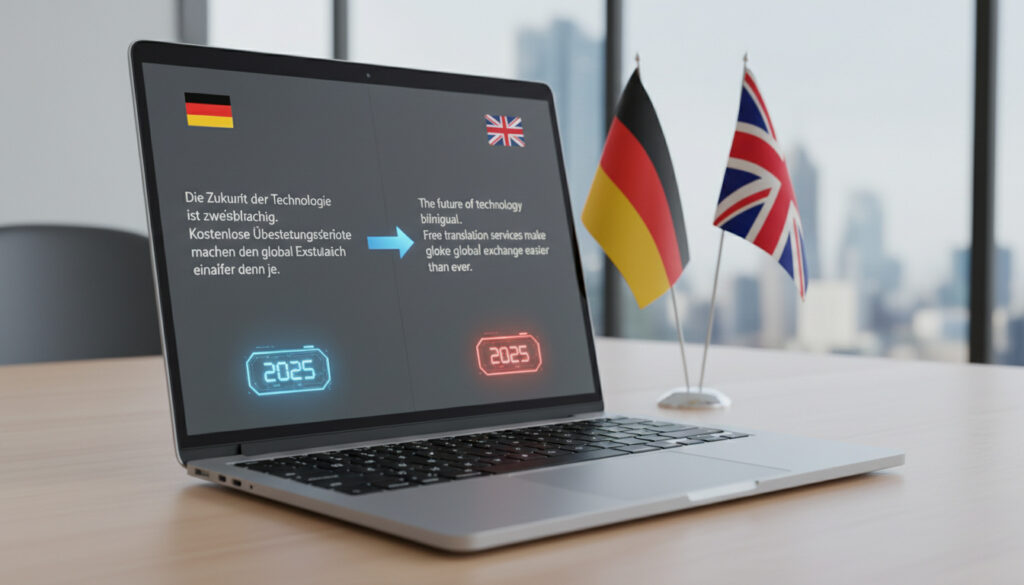
German to English Translation – Best Free Tools 2025
German and English represent one of the most actively translated language pairs globally. Whether navigating business contracts, academic papers, or casual travel conversations, users increasingly depend on free digital tools that deliver instant results. Recent advances in neural machine translation have narrowed the quality gap between automated services and professional human translation for many text types.
The landscape of free German to English translation tools in 2025 features distinct leaders. DeepL and Google Translate dominate benchmarks, each excelling in different contexts. DeepL reportedly produces more natural phrasing for formal documents, while Google Translate offers broader accessibility across devices and input methods.
Selecting the appropriate service requires understanding specific limitations. Free tiers impose character restrictions or exclude document processing. Accuracy varies significantly between simple sentences and complex technical jargon. Current capabilities reflect independent 2025 benchmarks and user testing data.
What is the best free German to English translation tool?
Several services compete for dominance in the German-English space, but two platforms consistently separate from the pack. DeepL earns recognition for translation quality, particularly with nuanced formal texts. Google Translate maintains superiority in versatility and accessibility across 133 languages.
| Tool | Free Tier Limits | Accuracy Focus | Platform Availability |
|---|---|---|---|
| DeepL | 5,000 characters per translation | Highest for formal/business texts | Web, iOS, Android, Desktop |
| Google Translate | Unlimited | Very good for casual use | Web, iOS, Android |
| Collins Dictionary | Full free access | Strong dictionary integration | Web only |
| Microsoft Translator | Unlimited personal use | Good for business integration | Web, iOS, Android, Windows |
Independent testing reveals distinct strengths across these platforms. Users should consider specific use cases before selecting a primary tool.
- DeepL produces more natural phrasing for German business and academic documents according to 2025 benchmarks
- Google Translate handles 133 languages and offers offline functionality without cost barriers
- Collins Dictionary combines translation with grammatical context and usage examples
- Microsoft Translator integrates directly with Office 365 for document workflows
- Free tiers generally exclude file uploads and API access requiring premium subscriptions
- Mobile availability varies, with DeepL and Google offering full iOS and Android support
- No automated tool guarantees perfect accuracy for legal or medical terminology
Detailed feature specifications for the top five services appear in the comparison below.
| Service | Instant Translation | Document Support | Mobile App | Offline Mode | Audio Output | Best Use Case |
|---|---|---|---|---|---|---|
| DeepL | Yes | Pro only | Yes | No | Yes | Professional correspondence |
| Google Translate | Yes | Yes | Yes | Yes | Yes | Travel and quick phrases |
| Collins | Yes | No | No | No | Yes | Vocabulary verification |
| Microsoft Translator | Yes | Yes | Yes | Yes | Yes | Business meetings |
| Linguee | Lookup only | No | iOS only | No | No | Context research |
| Reverso | Yes | Limited | Yes | No | Yes | Language learning |
How do you use Google Translate effectively for German text?
Google Translate remains the most accessible entry point for German translation needs. The platform supports multiple input methods beyond standard typing, including voice recognition, camera scanning, and handwriting detection.
Configuring German input and output
Users access the service through translate.google.co.uk or mobile applications. Selecting German as the source language and English as the target initiates instant processing. The application automatically detects German text when set to auto-detect mode, though manual selection improves accuracy with short phrases.
The mobile interface provides additional functionality unavailable on desktop versions. Users can download offline language packs for German, enabling translation without internet connectivity. This feature proves essential for travelers navigating areas with limited connectivity. Camera translation overlays English text onto German signs in real time through augmented reality.
Download German language packs before traveling to ensure translation capability without data roaming. Access this through the mobile app settings menu under “Offline translation.” The packs require approximately 50MB of storage space.
Accuracy expectations for German content
Independent testing indicates Google Translate handles simple German sentences with high accuracy. Complex grammatical structures, including separable verbs and subordinate clause word order, occasionally produce awkward phrasing. The service excels with contemporary colloquial German but struggles with regional dialects and archaic expressions.
Users seeking Google Find My Device integration will find similar account-based synchronization across Google services, though translation history remains separate from other Google data streams.
Which German to English translation app performs best?
Mobile translation apps differ significantly from their web counterparts in interface design and offline capabilities. DeepL and Google Translate offer the most robust iOS and Android experiences, though feature disparities exist between platforms.
DeepL mobile precision
The DeepL mobile application maintains the service’s reputation for nuanced translation quality. Users can translate text up to 5,000 characters per request without cost. The interface supports camera input for translating text in images, though this feature requires stable internet connectivity. Unlike the desktop version, mobile users cannot upload documents for translation in the free tier.
Google Translate versatility
Google’s mobile offering provides the most comprehensive feature set for German translation. Conversation mode enables bilingual dialogue by automatically detecting which language is spoken. The app supports handwriting input for German characters and symbols not available on standard English keyboards. According to mobile benchmarks, Google Translate leads in voice recognition accuracy for German dialects.
Free users of DeepL face a 5,000-character limit per translation request. Google Translate imposes no character restrictions but may truncate very long texts in camera translation mode. For extended documents, consider segmenting text into logical paragraphs.
How can you translate German sentences accurately?
Effective sentence translation requires more than single-word substitution. German sentence structure, with verbs frequently positioned at the end of subordinate clauses, demands contextual processing that basic dictionary lookups cannot provide.
Automated tools often fail with German idioms like “Tomaten auf den Augen haben” (having tomatoes on one’s eyes). Literally translated phrases may confuse English readers. Always verify idiomatic translations against contextual databases like Linguee before using them in professional contexts.
Step-by-step translation workflow
For optimal results, users should follow a structured approach. First, paste the German sentence into DeepL to obtain a baseline translation. Next, compare this output with Google Translate to identify discrepancies. Finally, consult Collins Dictionary for individual word verification if uncertainty persists.
Segmenting complex sentences improves accuracy. Breaking compound sentences into discrete clauses before translation often yields better results than processing lengthy paragraphs as single units. Step-by-step guides recommend testing short sentences first before tackling technical documentation.
Post-translation verification
Professional translators recommend reverse verification for critical texts. Translating the English output back into German reveals potential meaning shifts. Tools like Quillbot can refine English phrasing after initial machine translation, though this adds processing steps.
How has German to English translation technology evolved?
The progression from rule-based systems to neural networks dramatically improved German translation quality over the past two decades. Key developments established the current landscape of free translation tools.
- : Google launches statistical machine translation, replacing rule-based systems with probability models
- : Google transitions to neural machine translation, enabling context-aware processing of German sentence structure
- : DeepL enters the market, introducing superior handling of European language pairs including German-English
- : Mobile applications achieve parity with desktop translation quality through optimized neural networks
- : Large language models integrate into translation workflows, enabling conversational context retention
- : Independent benchmarks confirm DeepL’s accuracy superiority for formal German texts
What capabilities are established versus uncertain in translation technology?
Understanding the boundary between proven performance and experimental features helps users set realistic expectations for free translation tools.
| Established Information | Information That Remains Unclear |
|---|---|
| DeepL produces more natural phrasing for formal German business documents | Consistency when translating archaic or Middle High German texts |
| Google Translate supports 133 languages with functional German capabilities | Accuracy rates for highly specialized medical terminology |
| Offline language packs function without internet connectivity | Performance on handwritten German script recognition |
| Voice input recognizes standard German and major dialects | Legal validity of machine-translated documents in international courts |
| Camera translation works effectively on printed German text | Consistency across different PDF formatting styles |
What technical challenges distinguish German to English translation?
German presents unique obstacles for automated translation systems. The language’s propensity for compound nouns creates single words that require multiple English words to translate. For example, “Donaudampfschifffahrtsgesellschaftskapit” represents a single conceptual unit that English must render as separate words. For a deeper dive into specific language pairs, consider this Переклад з в’єтнамської на англійську.
Grammatical gender and case systems add complexity absent in English. Automated tools must determine whether “der,” “die,” or “das” translates to “the” based on grammatical case rather than meaning alone. Technical documentation, such as specifications for the BMW 4 Series Gran Coupe, requires precise handling of engineering terminology that general translation models may not prioritize.
Separable verb prefixes and modal particle usage further complicate sentence-level translation. Context determines whether “anfangen” should translate as “to begin” or whether the separable prefix “an-” requires repositioning in English word order.
What do independent evaluations conclude about translation quality?
Recent assessments from language technology reviewers provide quantitative backing for user observations. Testing methodologies typically compare identical source texts across multiple platforms to evaluate fluency and accuracy.
DeepL leads in accuracy for German-to-English translations, outperforming Google Translate in natural phrasing and context, especially for formal texts, based on multiple 2025 reviews and benchmarks.
— Maestra AI Translation Analysis, 2025
Free tools handle basic sentences well but struggle with jargon or colloquialisms without editing. Combining multiple services yields better results than relying on any single platform.
— Learn German Online Technical Review
User reviews consistently praise DeepL for “human-like” output quality while acknowledging Google’s superior accessibility features. Limitations remain across all free platforms, particularly regarding document formatting preservation and specialized terminology.
What strategy works best for German translation needs?
Optimal German to English translation requires tool selection based on content type. DeepL serves formal documents and business correspondence where nuance matters. Google Translate accommodates travel needs and quick queries requiring multimodal input. Combining both services—using Google for draft translations and DeepL for refinement—maximizes accuracy while maintaining workflow efficiency. For specialized terminology in fields like German automotive engineering, supplementary verification against dedicated dictionaries remains essential.
Frequently asked questions
Is DeepL better than Google Translate for German business documents?
Yes. Independent 2025 benchmarks indicate DeepL produces more natural phrasing for formal German texts, including business and legal documents. Google Translate handles casual conversation and travel phrases more efficiently.
Can I translate German PDFs using free tools?
Google Translate supports document uploads in its free tier. DeepL restricts document translation to premium subscribers. Formatting may not preserve perfectly in free conversions.
What is the character limit for free DeepL translations?
DeepL imposes a 5,000 character limit per translation request on free accounts. Google Translate offers unlimited character translation but may process long documents in segments.
Are offline German translation packs accurate?
Google Translate’s offline packs provide reasonable accuracy for common phrases but lack the neural network updates available online. DeepL does not currently offer offline functionality.
Why do tools struggle with German idioms?
German idioms often rely on cultural context and compound metaphors that lack direct English equivalents. Literal translations produce confusing results. Verify idioms against contextual databases like Linguee.
Can I use these tools for certified legal translations?
No. Free translation tools do not provide legally certified translations. Official documents require human translators with court accreditation. Machine translation suffices for comprehension only, not legal submission.
Does Google Translate support German dialects?
Google Translate recognizes major German dialects including Bavarian and Swiss German variants, though accuracy decreases compared to standard High German. DeepL focuses primarily on standard German.
More related posts
 Cat Spay Near Me: Cost Guide, Recovery Tips & Free Options
 Scotland v New Zealand – 2026 Tickets Date TV Guide
 Innocent (TV Series) – Plot, Cast, Episodes Guide
 Manchester City 115 Charges: Status and Latest News
 How to Cut Your Own Hair – Step-by-Step Beginner Guide
 Eintracht Frankfurt vs Aston Villa: Results, Lineups & Stats
 Scotland v New Zealand – 2026 Tickets Date History
 UK 2025 Pensioners TV License – Free Eligibility Rules
