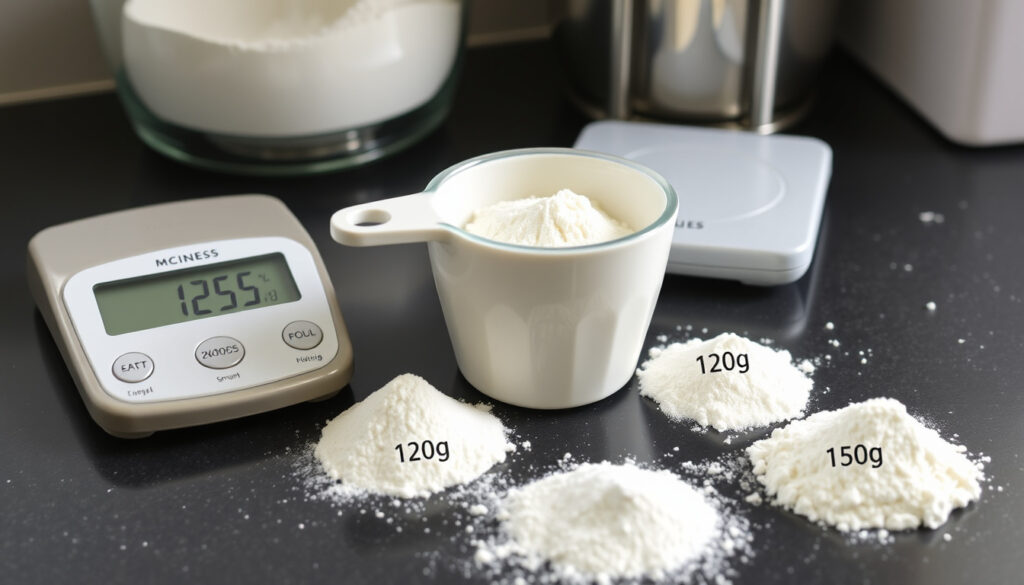
1 Cup Flour in Grams: 120g, 125g, or 150g Explained
Anyone who has pulled out a US recipe and stared at “1 cup flour” while the kitchen scale sits in grams knows the feeling. The answer should be simple — yet search around and you will find 120 g, 125 g, and even 150 g all given as correct.
King Arthur Baking (all-purpose flour, spooned): 120 g · Allrecipes (all-purpose flour, dip-and-sweep): 125 g · Doves Farm (plain flour): 120 g · Common cake flour conversion: 110 g
Quick snapshot
- King Arthur Baking lists 1 cup all‑purpose flour = 120 g (King Arthur Baking ingredient weight chart)
- Allrecipes lists 1 cup all‑purpose flour = 125 g (Allrecipes conversion guide)
- Doves Farm lists 1 cup plain flour = 120 g (Doves Farm conversion table)
- Janie’s Mill lists 1 cup all‑purpose flour = 125 g (Janie’s Mill weight chart)
- Whether the 150 g per cup figure refers to a different flour type, a dense scoop, or a rounding error
- Exact impact of humidity and brand on cup weight — no single study quantifies the variance
- Origin of the 250 g per cup metric sometimes used in older UK recipes
- King Arthur Baking standardised on 120 g over a decade ago; Allrecipes uses 125 g; the gap has never been reconciled (Doves Farm)
- Australian metric cup (250 ml) vs US cup (240 ml) adds a systematic 4 % difference (Doves Farm)
- Adopt weight‑based baking using a digital scale for consistent results
- Always check which measuring method the recipe author used (spoon‑and‑level vs dip‑and‑sweep)
A home baker using the “wrong” conversion can add 5–15 g of extra flour per cup — enough to turn a tender cake dry or a chewy cookie cakey. That is the practical consequence of a number that looks small on paper.
Key facts at a glance
Six authoritative sources, six different numbers. The table below shows how much 1 cup of flour weighs depending on who you ask and how they measure.
| Source | Flour type | Weight per cup | Method note |
|---|---|---|---|
| King Arthur Baking | All-purpose | 120 g | Spooned and levelled |
| Allrecipes | All-purpose | 125 g | Dip‑and‑sweep |
| Doves Farm | Plain flour | 120 g | Unsifted |
| Doves Farm | Sieved flour | 110 g | Sifted before measuring |
| Janie’s Mill | All-purpose | 125 g | Standard scoop |
| Janie’s Mill | Bread flour | 140 g | High‑protein blend |
| Janie’s Mill | Pastry flour | 111 g | Soft wheat |
| Janie’s Mill | Cake flour | 119 g | Fine‑textured |
| Janie’s Mill | Einkorn flour | 103 g | Ancient grain, lightest |
| Annie’s Noms | All-purpose / bread flour | 140 g | Standard cup |
| PastryCal | All-purpose (spoon‑and‑level) | 120–125 g | Light scoop |
| PastryCal | All-purpose (scooped) | 135–150 g | Dense pack |
The pattern: authority and method decide your gram count. King Arthur and Doves Farm push 120 g; Allrecipes and Janie’s Mill prefer 125 g; and denser scoops push toward 150 g. For your own baking, matching the source’s method matters more than any single number.
Is 1 cup of flour 120 g or 150 g?
Why the discrepancy exists
- Flour is a granular solid that compresses when scooped. A lightly spooned cup traps more air; a dipped and swept cup packs tighter. The difference can reach 20 g per cup according to PastryCal, a baking conversion resource.
- Regional cup sizes add another layer. Doves Farm notes that the US cup is 240 ml, while Australian, Canadian, and South African cups are 250 ml (Doves Farm conversion table).
- Flour type changes density: protein‑heavy bread flour packs more grams per cup than soft cake flour.
Standard conversion by King Arthur Baking
King Arthur Baking, one of the most trusted names in US baking, states on its Ingredient Weight Chart that 1 cup of all‑purpose flour weighs 120 g. The method: spoon flour into the cup, then level with a straight edge. This is the lightest standard among major US publishers.
Standard conversion by Allrecipes
Allrecipes uses 125 g per cup of all‑purpose flour (Allrecipes Cup to Gram Conversions). Their method leans toward a dip‑and‑sweep, which packs slightly more flour into the same volume. The 5 g gap seems trivial, but over 3 cups it becomes 15 g — enough to shift dough hydration.
How to determine which to use
Check the source of the recipe. If the author is a US baker who cites King Arthur, use 120 g. For a general US site like Allrecipes, 125 g is safer. For UK or Australian recipes, Doves Farm’s 120 g per cup (with the 250 ml cup in mind) is a reliable baseline (Doves Farm).
A baker who always uses 120 g will produce slightly leaner doughs than one using 125 g. Neither is wrong — the key is to be consistent so your favourite recipes reproduce every time.
What this means: you have to pick a camp. King Arthur loyalists stick at 120 g; Allrecipes followers settle on 125 g. The consequence is that your dough hydration will shift by about 5 g per cup — enough to notice in delicate recipes.
Is 1 cup of flour 125 grams?
The 125 g conversion explained
Yes, 125 g is the most common number across US recipe sites. The USDA standard for all‑purpose flour also rounds to 125 g per cup, making it a de facto reference. Janie’s Mill, a specialty flour producer, uses 125 g for its all‑purpose flour and 140 g for its high‑protein bread flour (Janie’s Mill weight chart).
How measurement method affects weight
- Spoon‑and‑level: about 120 g. Air pockets remain; flour sits loosely.
- Dip‑and‑sweep: about 125–140 g. The cup is plunged into the bag, packing more flour.
- Sifted then spooned: about 110–115 g as noted by Doves Farm (Doves Farm) and PastryCal.
When to use 125 g vs 120 g
If the recipe writer explicitly provides a weight, use that. If the recipe only gives cup measures and comes from a US source, 125 g is a safe default. If you are following a King Arthur Baking recipe, stick with 120 g to match their internal standard.
Is 250 g of flour 1 cup?
Converting 250 g to cups
No — 250 g is roughly 2 cups using the 125 g standard, or about 2.08 cups using the 120 g standard. Some older UK recipe books treat 1 cup as 250 g, but that aligns with a 250 ml cup and a different flour density (Doves Farm).
Why 250 g is not exactly 2 cups
If 1 cup = 120 g (King Arthur), then 250 g ÷ 120 g = 2.08 cups. If 1 cup = 125 g (Allrecipes), 250 g equals exactly 2 cups. The mismatch illustrates why professional bakers insist on weights: a cup is a volume, flour is a variable-density solid.
How to accurately measure 250 g flour
Use a digital scale. Scoop or spoon flour into the bowl until the display reads 250 g. That single step eliminates the difference between spoon‑and‑level and dip‑and‑sweep entirely.
How much is 1 cup of white flour?
Weight of all‑purpose flour
120–125 g is the consensus range among US sources. The USDA standard is 125 g. Janie’s Mill reports 125 g for its all‑purpose flour (Janie’s Mill).
Weight of bread flour
Bread flour has a higher protein content and packs denser. Janie’s Mill gives 140 g per cup (Janie’s Mill). Annie’s Noms also lists 140 g for bread flour (Annie’s Noms cup conversions).
Weight of cake flour
Lighter and finer, cake flour weighs less per cup. Janie’s Mill lists 119 g, while Doves Farm gives about 110 g when sieved (Doves Farm).
Weight of self‑rising flour
Self‑rising flour (plain flour with added leavening) falls in the same range as all‑purpose: 120–125 g per cup. Annie’s Noms groups it at 140 g per cup (Annie’s Noms), but most US sources place it closer to 125 g.
Is 2 cups of flour 500 g?
The 2 cups = 500 g equivalence
Only if you assume 1 cup = 250 g, which contradicts standard flour density. For that to hold, the cup would need to be packed extremely dense — roughly 150 g per cup would still fall short. More commonly, 4 cups of all‑purpose flour at 125 g each equal 500 g.
Why some bakers see 4 cups = 500 g
Using the 125 g standard, 4 cups × 125 g = 500 g. That is a tidy number, which may explain why some older cookbooks and UK references settled on 1 cup = 125 g. The confusion arises when newer recipes use 120 g, making 4 cups = 480 g.
Common conversion mistakes
The biggest pitfall: assuming all flour types weigh the same. A cup of einkorn flour weighs 103 g; a cup of bread flour can weigh 140 g (Janie’s Mill). Using a one‑size‑fits‑all multiplier (like 250 g per cup) guarantees error.
A cake recipe calling for 2 cups of flour could yield 240 g, 250 g, or 280 g depending on which conversion you use. That 40 g spread is the difference between a tender crumb and a dry one.
The catch: if you blindly use 250 g per cup, you’ll over‑flour every recipe. Stick with 120–125 g per cup and adjust based on the source’s method.
How the major conversion systems compare
Three widely used references, three slightly different numbers — the table below shows how they stack up side by side.
| Reference system | All‑purpose flour (per cup) | Method used | Region |
|---|---|---|---|
| King Arthur Baking | 120 g | Spoon‑and‑level | US |
| Allrecipes | 125 g | Dip‑and‑sweep | US |
| Doves Farm | 120 g | Unsifted, US cup (240 ml) | UK |
| Janie’s Mill | 125 g | Standard scoop | US |
| Annie’s Noms | 140 g | Standard cup (all‑purpose / bread) | US / UK blend |
The pattern: even within US references, the gap stretches from 120 g to 140 g. The implication is clear — always check the source’s measurement method before picking a number.
Weight vs volume: the trade‑offs
Upsides
- Weight eliminates variability from scooping technique
- Digital scales cost less than £15 and last for years
- Professional bakers and test kitchens rely on weight for consistency
- Easy to scale recipes up or down with simple maths
Downsides
- Most US home recipes still list only volume measurements
- Switching to weight requires a conversion chart or app
- Cups are faster for experienced cooks who rely on feel
- Scales need batteries and occasional calibration
What this means: the scale wins for precision, but cups still dominate US recipe writing. The compromise is to keep a conversion chart handy and use weight when the recipe outcome matters.
How to measure flour accurately by weight
- Set your scale to grams and place a bowl on it. Tare to zero.
- Whisk or fluff the flour in its container to break up compaction.
- Spoon the flour gently into the bowl until the display reads the target weight. Do not scoop directly from the bag into the bowl — that compacts it.
- Level mentally: if you need 120 g and overshoot, remove flour with a spoon, not by tapping the bowl (tapping settles the flour).
- Write down the weight the first time a recipe works perfectly, so you can reproduce it forever.
Janie’s Mill explicitly recommends using a kitchen scale for accurate ingredient measurements every time (Janie’s Mill weight chart). Doves Farm adds that its cups‑to‑grams table is a guideline, and proportions work best when the same cup is used for all ingredients (Doves Farm guidelines).
What we know for sure — and what remains unclear
Confirmed facts
- 1 cup of sifted flour weighs less than unsifted — about 110 g vs 120 g (Doves Farm)
- 120 g is the standard for the spoon‑and‑level method used by King Arthur Baking
- 125 g is the standard for the dip‑and‑sweep method used by Allrecipes and the USDA
- Different flour types (bread, cake, pastry, einkorn) produce different weights per cup (Janie’s Mill)
What’s unclear
- Whether the 150 g per cup figure sometimes seen online refers to a specific flour type, a dense scoop, or a transcription error
- Exactly how much humidity and brand variation affect cup weight in practice
- The origin of the 250 g per cup metric found in some older UK recipes — it may be a rounding legacy rather than a measured standard
The implication: the confirmed facts give you a reliable range (110–150 g); the unclear items remind you not to trust a single number without context.
Expert sources on flour measurement
For best results, we recommend weighing your ingredients with a digital scale. A cup of all‑purpose flour weighs 120 grams or 4 1/4 ounces.
— King Arthur Baking, Ingredient Weight Chart
Flour, 120 g, 90 g (for unsifted and sifted respectively).
— Doves Farm, Cups to Grams Conversion Table
All‑Purpose Flour: 1 cup = 125 g.
— Allrecipes, Cup to Gram Conversions
What this means: three authoritative sources, three different numbers — the only way to reconcile them is to match your technique to the source you trust.
What this means for your baking
The “1 cup flour in grams” question has no single right answer — and that is exactly the point. Weight varies by measuring method, flour type, cup size, and even humidity. The consequence for home bakers is clear: pick one standard (120 g or 125 g for all‑purpose), stick with it, and invest in a digital scale. For anyone who bakes more than once a week, the choice is simple — weigh your flour, or accept that your results will drift.
For a deeper dive into the exact weights, check out precise conversion charts that break down the differences by flour type and scooping method.
Frequently asked questions
What is the weight of 1 cup of bread flour?
Bread flour is denser due to its higher protein content. Janie’s Mill lists 140 g per cup (Janie’s Mill weight chart). Annie’s Noms also reports 140 g for bread flour (Annie’s Noms cup conversions).
How does sifting affect flour weight?
Sifting aerates flour, reducing its density. Doves Farm gives 110 g per cup for sieved flour compared with 120 g for unsifted (Doves Farm conversion table). PastryCal similarly notes 110–115 g for sifted all‑purpose flour (PastryCal guide).
Why do some recipes specify 120 g and others 125 g?
The difference comes down to measuring technique. King Arthur Baking uses the spoon‑and‑level method (120 g), while Allrecipes uses dip‑and‑sweep (125 g). Both are correct within their own system.
Should I use weight or volume for baking?
Weight is more accurate and consistent. Professional bakers and major test kitchens all recommend weighing ingredients. Janie’s Mill advises using a kitchen scale for accurate measurements every time (Janie’s Mill).
How many grams is 1 cup of whole wheat flour?
Whole wheat flour is denser than all‑purpose. Most conversion charts place it at 120–130 g per cup. King Arthur Baking lists 1 cup of whole wheat flour at 120 g (King Arthur Baking ingredient weight chart).
What is the weight of 1 cup of gluten‑free flour?
Gluten‑free flour blends vary by brand, but a typical all‑purpose gluten‑free blend weighs about 120–140 g per cup. Always check the brand’s specific conversion chart for the most accurate number.
How do I convert grams to cups for flour?
Divide the gram weight by the per‑cup conversion factor you choose. For 120 g per cup: grams ÷ 120 = cups. For 125 g per cup: grams ÷ 125 = cups. The result will differ, so stay consistent within a single recipe.
The takeaway: the FAQ answers reinforce that conversion is not one-size-fits-all — your choice of 120 g or 125 g depends on the source and method.
Related reading: Easy Dinner Recipes for Family · 95 kg in Stone and Pounds: Exact Conversion Guide
More related posts
 Air India Plane Crash Pilot – Cause Theories and Updates
 The Fantastic Four First Steps – Release Date, Cast, Box Office
 How Many Days Until Christmas? 2026 Countdown Timer
 Who Is the Most Powerful Doctor in the World – Tedros’ Global Authority
 Peter Kay Health: Kidney Procedure, Weight Loss & Personal Life
 Things to Do in Dubrovnik – Top Attractions and Tips
 Cast of His & Hers – Netflix 2026 Cast & Character Guide
 Audio Books Guide: Free Apps, Audible Alternatives & Tips
