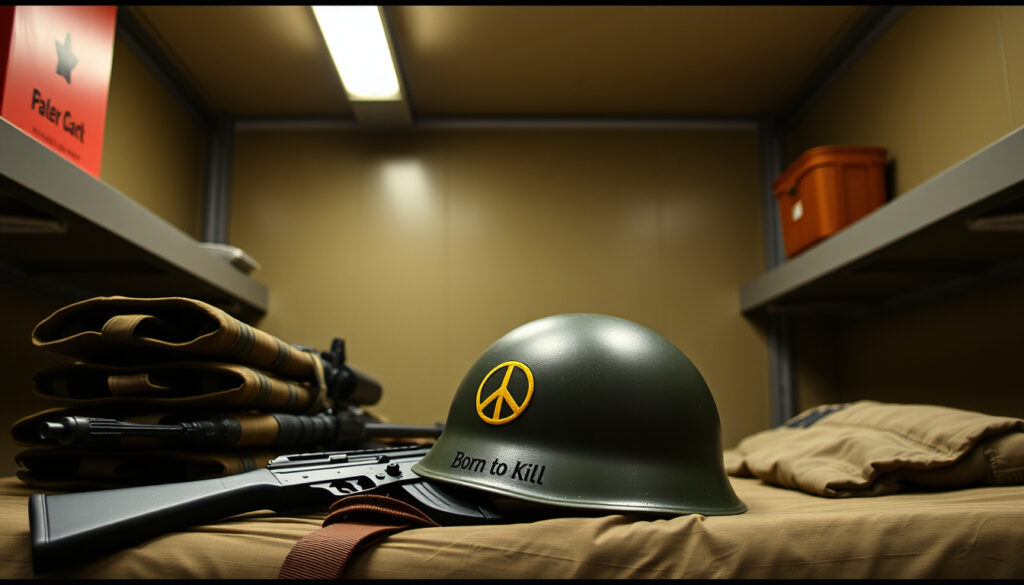
Cast of Full Metal Jacket – Actors, Characters and Roles
Full Metal Jacket (1987) – Full Cast and Crew
Stanley Kubrick’s 1987 war film Full Metal Jacket remains one of cinema’s most influential portrayals of military training and combat. The movie divides into two distinct acts: the brutal boot camp sequence at Parris Island and the chaotic Vietnam deployment that follows. Each section features a cast that brought extraordinary authenticity to their roles, with several performers drawing directly from their own military backgrounds.
The screenplay, co-written by Kubrick with Michael Herr and Gustav Hasford, draws from Hasford’s 1979 autobiographical novel The Short-Timers. This source material provided the foundation for performances that would define the characters of Joker, Pyle, and Hartman in popular culture. The cast selection process proved equally important, resulting in a blend of established performers and lesser-known actors who delivered what many consider career-defining work.
Understanding who played each role offers insight into why Full Metal Jacket maintains its impact nearly four decades after release. From the method acting of D’Onofrio gaining 70 pounds for his screen debut to Ermey’s improvised verbal attacks that drew from genuine military experience, the casting choices elevated the material beyond typical war film conventions.
Who Are the Main Cast Members of Full Metal Jacket?
The principal cast anchors the film’s two-act structure, with specific actors dominating each section. Boot camp sequences feature Ermey, D’Onofrio, and Modine prominently, while Vietnam scenes showcase Baldwin, Harewood, Howard, and Howard in ensemble work. The following overview highlights the four performers whose roles shape the narrative’s trajectory.
Key Facts About the Cast
- R. Lee Ermey was a former drill sergeant in the United States Marine Corps, lending authenticity to Hartman that went beyond script preparation.
- Vincent D’Onofrio’s performance as Pyle marked his feature film debut and led to prominent roles in Men in Black and Law & Order: Criminal Intent.
- Tim Colceri, a former Marine, was originally cast as Hartman before Ermey ultimately received the role, with Kubrick reassigning Colceri to the helicopter door gunner part.
- Stanley Kubrick provided the uncredited voice of Sergeant Murphy, the radio contact Cowboy communicates with during Vietnam sequences.
- Kevyn Major Howard, who played Rafter Man, later appeared in Death Wish II, Alien Nation, and Miami Vice before this role.
- The film’s dual-structure required cast members to transition between the controlled environment of boot camp and the chaotic combat zones of Vietnam.
| Actor | Character | Notable Fact |
|---|---|---|
| Matthew Modine | Joker (Pvt./Sgt.) | Kept set diary later published as book and app |
| R. Lee Ermey | Gunnery Sgt. Hartman | Real drill instructor background |
| Vincent D’Onofrio | Pvt. Pyle | 70-pound weight gain for role |
| Adam Baldwin | Animal Mother | Character defined by killing pride |
| Dorian Harewood | Cpl. “Eightball” | Unfazed by racial slurs in film |
| Arliss Howard | Pvt. “Cowboy” | Friend of Joker from Texas |
| Kevyn Major Howard | PFC “Rafter Man” | Combat photographer role |
| Ed O’Ross | Lt. Schinoski | Platoon leader callsign “Touchdown” |
Who Played Private Pyle in Full Metal Jacket?
Vincent D’Onofrio’s Breakthrough Role
Vincent D’Onofrio delivered what would become his feature film debut as Private Leonard Lawrence, nicknamed “Gomer Pyle” by his fellow recruits. The casting decision proved unconventional, as D’Onofrio’s background did not include military experience or typical action-hero attributes. However, Kubrick recognized something in the young actor that aligned perfectly with the character’s transformation from clumsy recruit to broken soldier.
Preparation for the role required extraordinary physical commitment. D’Onofrio gained approximately 70 pounds to portray the overweight recruit whose poor performance draws increasing scrutiny from Drill Instructor Hartman. This transformation extended beyond appearance, as D’Onofrio studied footage of military recruits struggling with training requirements to inform his physicality and emotional responses. His career trajectory since that breakthrough performance demonstrates the lasting impact of such immersive preparation, as documented in various career retrospectives.
D’Onofrio’s performance in Full Metal Jacket launched a career that includes prominent roles in Men in Black and Jurassic World, television detective work in Law & Order: Criminal Intent, and villain performances in Daredevil and The Batman.
Pyle’s Arc in the Film’s Structure
Private Pyle functions as Hartman’s primary focus during boot camp, with the drill instructor dedicating extraordinary energy to breaking the struggling recruit. The sustained verbal attacks create tension that builds throughout the training sequence, ultimately reaching a breaking point that transforms Pyle into a hardened Marine capable of extreme violence.
This transformation establishes thematic groundwork that extends into the Vietnam portion of the film. The same psychological mechanisms that create combat-ready soldiers also create individuals capable of the atrocities depicted in later scenes. Pyle’s trajectory illustrates this cost of military conditioning more directly than any other character.
Who Played the Drill Sergeant Gunnery Sergeant Hartman?
R. Lee Ermey’s Military Background
R. Lee Ermey portrayed Gunnery Sergeant Hartman, and unlike most actors in military roles, Ermey possessed direct experience as a drill instructor in the United States Marine Corps. His service as a drill sergeant provided authentic vocabulary, tone, and psychological approaches that informed the character. This background distinguished his performance from actors who relied on script reading and physical training alone.
Ermey’s casting resulted from an unusual path. Tim Colceri, also a former Marine, initially received the role, but Ermey’s audition demonstrated capabilities that impressed Kubrick sufficiently to reassign the part. Colceri received the smaller helicopter door gunner role instead, a decision that reflected Kubrick’s respect for both performers’ military credentials.
Ermey improvised much of Hartman’s dialogue, drawing on techniques he observed and experienced during his own military service. Kubrick allowed this freedom because Ermey’s authentic military knowledge exceeded what any script could provide.
Hartman’s Role in the Film’s Themes
Hartman serves as the embodiment of military conditioning systems, his volume and aggression designed to strip recruits of civilian identities and rebuild them as unit-compatible soldiers. His verbal attacks target individual weaknesses while simultaneously fostering group cohesion through shared suffering. The effectiveness of this training process becomes clear when recruits perform flawlessly during inspection sequences.
The character’s influence extends beyond boot camp into the Vietnam narrative, where former recruits demonstrate the conditioned responses Hartman instilled. The contrast between his controlled environment and the chaos of combat creates irony regarding military training’s limitations. Hartman’s methods produce soldiers, but the soldiers face situations training never fully anticipated.
Who Played Private Joker in Full Metal Jacket?
Matthew Modine’s Protagonist Role
Matthew Modine portrayed Private James T. Davis, known throughout the film as “Joker.” The character serves as both narrative protagonist and unreliable narrator, his sardonic observations framing the brutal events that unfold. Joker enters boot camp with awareness that distinguishes him from fellow recruits, maintaining skepticism that both protects him and creates friction with authority figures.
The role required Modine to balance dark humor against genuine horror, a tonal range that defines the film’s approach to war commentary. Joker’s famous helmet inscription “Born to Kill” paired with his peace symbol lapel creates visual irony the film revisits throughout both acts. This contradiction reflects broader themes regarding civilian attitudes toward warfare.
Modine’s On-Set Documentation
Modine maintained a diary throughout production that documented his experiences working with Kubrick. This record became a published book in 2005 titled Full Metal Jacket Diary, offering behind-the-scenes perspective on the demanding production. In 2013, Modine released a companion interactive app that expanded access to this material.
The diary reflects Modine’s commitment to the role and Kubrick’s intense direction style. Unlike more straightforward war films, Full Metal Jacket demanded psychological preparation that extended beyond traditional acting methods. Modine’s documentation provides insight into how these demands shaped performances and interpersonal dynamics on set. Reviews of the diary and app have praised their unfiltered glimpse into Kubrick’s demanding creative process.
Matthew Modine later appeared in Christopher Nolan’s The Dark Knight trilogy, establishing connections between influential directors and actors across different film eras.
Who Directed Full Metal Jacket and Key Production Roles?
Stanley Kubrick directed and produced Full Metal Jacket, bringing his characteristic attention to detail and extensive preparation to the war genre. The screenplay emerged from collaboration between Kubrick, journalist Michael Herr, and novelist Gustav Hasford, whose experiences in Vietnam provided source material. Hasford’s novel The Short-Timers formed the foundation for the film’s narrative structure and character dynamics.
Kubrick’s involvement extended beyond traditional directing into performance guidance and technical supervision. His preparation included extensive research into military training methods, with consultation from actual drill instructors. This approach aligned with his broader filmmaking philosophy that prioritized authenticity over conventional storytelling shortcuts.
Uncredited Contributions to the Film
Several individuals contributed without receiving formal credit. Kubrick himself provided the uncredited voice of Sergeant Murphy, the radio contact Cowboy speaks with during Vietnam sequences. His daughter Vivian Kubrick appeared as an uncredited News Camera Operator at the mass grave scene. These contributions reflected family involvement that extended through multiple Kubrick productions.
Tim Colceri’s casting journey demonstrated the film’s unconventional approach to military authenticity. Originally assigned the Hartman role before Ermey’s casting, Colceri accepted the helicopter door gunner part and delivered a memorable performance that drew from his own Marine Corps service. The role required him to portray cruelty that paralleled Hartman’s boot camp behavior.
Filming took place primarily in the United Kingdom, with locations including former military facilities converted to approximate Parris Island and Vietnamese settings. This production choice allowed Kubrick extended control over filming conditions and schedule. For a comprehensive look at the cast, you can explore the Актори American Horror Story.
Timeline: From Boot Camp to Combat Deployment
Full Metal Jacket structures its narrative across two distinct temporal phases, each featuring specific cast members according to the film’s division of labor. Understanding when characters appear helps clarify the ensemble structure and how performances connect to the film’s broader arc. Scholars studying film studies often cite this structural approach as a defining example of narrative innovation in war cinema.
- 1979: Gustav Hasford publishes The Short-Timers, his autobiographical novel drawing from Vietnam service.
- 1985-1986: Production for Full Metal Jacket takes place, primarily in the United Kingdom at converted military facilities.
- 1987: The film releases in theaters, introducing audiences to the divided structure Kubrick would employ.
- Boot Camp Sequence: Modine, Ermey, and D’Onofrio dominate the Parris Island training footage, establishing characters through Hartman’s verbal assaults.
- Transition Sequence: Joker and Pyle complete training and prepare for deployment, with Pyle’s transformation becoming complete.
- Vietnam Deployment: Baldwin, Harewood, Howard, and Howard appear as Lusthog Squad members, joined by Modine as Joker.
- Sniper Incident: The squad encounters a Viet Cong sniper (Ngọc Lê), leading to extended siege sequences.
- Pyle’s Death: The iconic moment where Pyle shoots Hartman before turning the weapon on himself occurs near the film’s climax.
- Final Sequences: The remaining squad members continue operations, with Joker’s narration providing closure.
This timeline demonstrates how the cast divides according to narrative location. The boot camp sequence functions as character establishment, while Vietnam sequences test those characters against combat realities. The cast’s transitions between these phases create continuity that supports the film’s thematic progression.
What We Know for Certain and What Remains Unclear
The cast information for Full Metal Jacket rests on established documentation from official sources including Wikipedia, IMDb, and primary production credits. Several facts remain consistently verifiable across multiple sources, while certain peripheral details warrant continued verification.
Established Information
- Matthew Modine played Joker throughout both boot camp and Vietnam sequences.
- R. Lee Ermey portrayed Gunnery Sergeant Hartman during boot camp only.
- Vincent D’Onofrio appeared as Private Lawrence “Gomer Pyle,” with his character surviving until the film’s climax.
- Adam Baldwin played Sergeant “Animal Mother,” the squad’s machine gunner during Vietnam.
- The film released in 1987 under Kubrick’s direction from a screenplay based on Hasford’s novel.
- Production occurred primarily in the United Kingdom rather than actual military locations.
Information Requiring Verification
- Specific improvisation instances during boot camp sequences require corroboration from multiple sources.
- Background details for supporting cast members vary across databases.
- Some character ages and personal histories contain discrepancies between sources.
Claims about specific dialogue being improvised should be verified against primary sources. Production documentaries and actor interviews provide the most reliable documentation of these details.
Full Metal Jacket in Context: Casting and Genre
The casting approach for Full Metal Jacket reflected broader trends in war filmmaking during the 1980s, a period when directors increasingly sought authenticity through non-traditional casting and intensive preparation. Kubrick’s methods aligned with emerging practices that prioritized psychological depth over action spectacle, creating character-driven war cinema that influenced subsequent productions.
Comparison with other war films from the era reveals distinctive choices. While Saving Private Ryan (1998) would later demonstrate similar attention to combat realism, Full Metal Jacket’s 1987 release preceded that approach. The casting of Ermey and Colceri, both with military backgrounds, provided authenticity that typical Hollywood casting could not achieve.
The ensemble structure allowed character development that served thematic purposes beyond plot advancement. Each recruit in Hartman’s platoon represents a different response to military conditioning, with Pyle and Joker occupying opposite ends of the adaptation spectrum. The Vietnam squad continues this character study, demonstrating how training effects manifest under combat stress.
For viewers interested in comparable ensemble casting, examining other action films from the same era reveals how Full Metal Jacket’s approach influenced genre development. The emphasis on character depth alongside action sequences represented a shift in war and combat filmmaking priorities.
Sources and Additional Reading
The cast information presented derives from multiple authoritative sources, with primary documentation from production credits and verified database entries. Wikipedia provides comprehensive cast listings with citations to primary sources. Screen Rant offers detailed character analysis drawing from production documentation. IMDb maintains official credits confirming role assignments.
“Ermey, who played Gunnery Sergeant Hartman, was a former drill sergeant himself, which brought significant authenticity to his portrayal.”
Official production documentation confirms the collaboration between Kubrick, Herr, and Hasford on the screenplay, with Hasford’s novel providing the foundational source material. Kubrick’s daughter Vivian’s uncredited appearance represents family involvement consistent with other Kubrick productions.
Additional resources include the original novel The Short-Timers, which expands character backgrounds beyond what the film depicts. Matthew Modine’s published diary offers behind-the-scenes perspective, while documentary materials provide production context. Warner Bros. maintains official distribution documentation for the film.
- Wikipedia: Full Metal Jacket — Comprehensive film article with cast details
- Screen Rant: Cast and Characters — Detailed character analysis
- Warner Bros. Official Page — Production and distribution information
Summary
The cast of Full Metal Jacket combines military authenticity with committed performances that elevated Kubrick’s vision above conventional war filmmaking. From Ermey’s genuine drill instructor background to D’Onofrio’s transformative physical preparation, each principal performer brought qualities that the material required. The ensemble structure supports the film’s divided narrative, with specific cast members dominating each act while maintaining continuity across the production.
Understanding who played each role provides context for the film’s enduring impact. The characters of Joker, Hartman, and Pyle have entered popular culture through quotable dialogue and memorable visual moments, achievements that depend entirely on the actors’ contributions. Whether examining boot camp sequences or Vietnam combat, the cast selections demonstrate how thoughtful casting decisions shape thematic outcomes.
Frequently Asked Questions
Is there a Full Metal Jacket 2?
No official sequel to Full Metal Jacket has been produced. Despite occasional rumors, there is no confirmed Full Metal Jacket 2 in development as of the most recent documentation.
Who played Animal Mother in Full Metal Jacket?
Adam Baldwin played Sergeant “Animal Mother,” the nihilistic machine gunner in the Lusthog Squad who takes pride in killing enemy soldiers.
What is R. Lee Ermey’s connection to the military?
R. Lee Ermey was a former United States Marine Corps drill instructor, which brought significant authenticity to his portrayal of Gunnery Sergeant Hartman.
How did Vincent D’Onofrio prepare for the role of Private Pyle?
D’Onofrio gained approximately 70 pounds to play the under-performing recruit Lawrence “Gomer Pyle” in what became his breakthrough performance.
Who did Matthew Modine play in Full Metal Jacket?
Matthew Modine played Private (later Sergeant) James T. “Joker” Davis, the protagonist and a wisecracking young Marine who serves as the film’s narrator.
Was Stanley Kubrick involved in the film’s production beyond directing?
Yes, Kubrick also provided the uncredited voice of Sergeant Murphy, the radio contact for Cowboy. His daughter Vivian Kubrick appeared uncredited as a News Camera Operator.
What was Tim Colceri’s original role in the casting process?
Tim Colceri, a former Marine, was originally cast as Hartman before R. Lee Ermey was chosen. Kubrick gave him the smaller helicopter door gunner role as a consolation.
What notable actors had early roles in Full Metal Jacket?
Vincent D’Onofrio, who later became known for Men in Black and Law & Order: Criminal Intent, had his breakthrough here. Kevyn Major Howard also appeared before his roles in Death Wish II and Miami Vice.
More related posts
 Matt Monro: Life, Music, and Death of the Golden Voice
 Premier League Table 2025 – Current Standings Arsenal Leads
 DVLA Swansea Contact Number Free 0300 – Official Numbers and Hours
 Leicester City Transfer News 2025: Signings, Departures & Rumours
 Linnea Berthelsen: Biography, Height, Languages, Stranger Things
 Man City vs AFC Bournemouth Stats – 18 Wins in 19 Matches
 Al Nassr vs Al Hilal – Result, Stats and Next Match
 Valley of the Rocks – Exmoor’s Dramatic Natural Wonder
