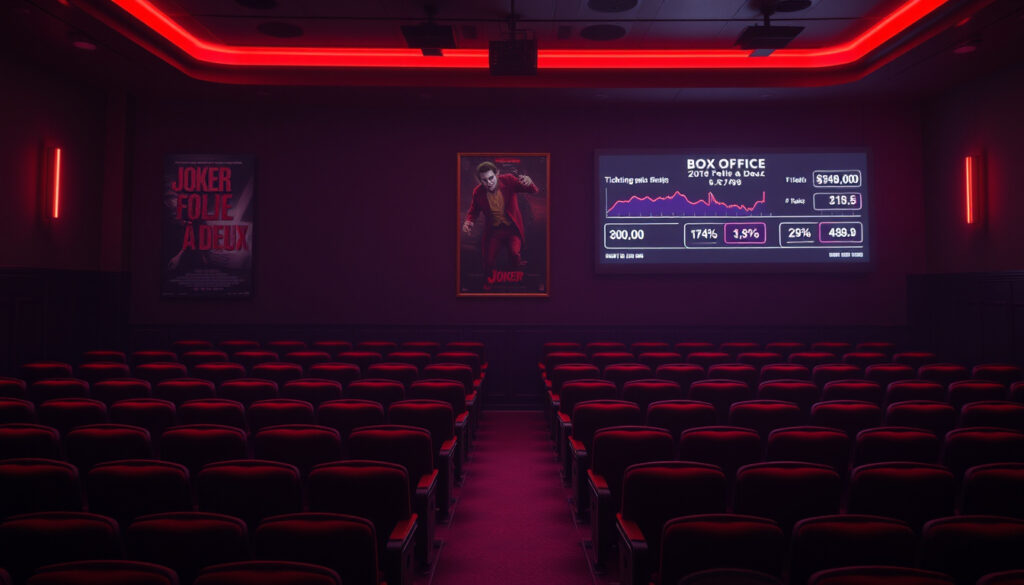
Joker Folie à Deux: Flop Analysis, Reviews & Box Office
The first Joker shocked the industry by becoming the first R-rated film to gross $1 billion worldwide on a lean $55 million budget, earning Joaquin Phoenix an Oscar along the way. Seven years later, its sequel spent $190–200 million on production alone—then promptly imploded at the box office. By the end of its theatrical run, Joker: Folie à Deux had earned roughly $207 million globally, landing it squarely among the most expensive flops in recent cinema history. This article maps out exactly why that happened, what critics and audiences said, and what it means going forward.
Release Year: 2024 · Lead Actor: Joaquin Phoenix · Co-Star: Lady Gaga · Predecessor: Joker (2019) · Setting: Arkham State Hospital
Quick snapshot
- Sequel to the 2019 Oscar-winning Joker (Wikipedia)
- Rotten Tomatoes critics score: 31% from 369 reviews (Rotten Tomatoes)
- CinemaScore grade: D — first such grade for a comic book adaptation (LA Times)
- Exact final loss figures beyond the $125–200 million estimates
- Lady Gaga’s reported salary — figures have not been officially confirmed
- Post-theatrical streaming and VOD revenue figures
- Warner Bros. faces projected losses of $125–200 million (Wikipedia)
- Film swept the 2025 Golden Raspberry Awards: Worst Sequel, Worst Screen Combo (Wikipedia)
- No announced plans for a third Joker film (Wikipedia)
Is Joker: Folie à Deux a flop?
By any financial measure, yes. The film earned $37.7 million in its domestic opening weekend from 4,102 theaters, according to Wikipedia — well below the $50–65 million analysts had projected. By comparison, the 2019 original opened to $96.2 million domestically, setting a record for October releases on its way to $1 billion worldwide, per LA Times. The sequel never came close to those numbers.
Box office performance
International debut gross reached $81.1 million, with worldwide opening totaling $121.1 million, LA Times reported. By the second weekend, domestic earnings collapsed to roughly $7 million — an 81% drop that set a record for any DC live-action film. The domestic total ended at $58.3 million, with international markets contributing $149.2 million, Wikipedia noted. The combined worldwide gross of $207.5 million against a $190–200 million budget qualifies it as a box office bomb.
Budget vs earnings
The break-even point was estimated at $450 million by Variety, or $375 million by Warner Bros., meaning the film fell roughly $170 million short of what it needed just to break even. Projected losses sit between $125–200 million, Wikipedia stated. Analysts called the scale of the failure extraordinary. “A Speed 2 level of disaster,” said Jeff Bock, a box office analyst at Exhibitor Relations, per Wikipedia.
Comparison to biggest flops
Joker: Folie à Deux became the sixth DC live-action film to underperform since The Batman (2022), joining Black Adam, Shazam: Fury of the Gods, The Flash, Blue Beetle, and Aquaman and the Lost Kingdom. Its US opening of roughly $40 million placed it below The Marvels ($46M) and roughly on par with Morbius ($39M), according to coverage on Dailymotion. One source close to the production described it as “complete audience rejection,” per Wikipedia.
Is the new Joker movie good?
Not by critical standards, and audiences agreed. The Rotten Tomatoes consensus reads: “Joaquin Phoenix’s eponymous Joker takes the stand in a sequel that dances around while the story remains still, although Lady Gaga’s wildcard energy gives Folie à Deux some verve.” That’s the charitable take.
Critical reception
The critics’ verdict was damning. Rotten Tomatoes gave it a 31% rating based on 369 reviews, with an average score of 4.9 out of 10, Wikipedia reported. French publications were particularly harsh. Vanity Fair called it “ennuyeux et sans intérêt” (boring and uninteresting), per Ozap. Le Monde described it as “show inégal,” noting a lack of inventiveness. Première went further, calling the film “a musical dépressif so dreary and ineffective it resembles almost a deliberate scuttling by Todd Phillips and Joaquin Phoenix,” per Ozap. The Hollywood Reporter found it “un peu léger voire parfois fade” (somewhat light or sometimes bland), per Ozap.
Audience reviews
Audiences were equally unkind. The CinemaScore poll — the industry standard for gauging viewer reaction — gave Joker: Folie à Deux a D, the first such grade ever recorded for a comic book adaptation, per LA Times. The Rotten Tomatoes audience score hovered around 33%, Ozap noted. Vulture’s assessment was blunt: “Joker, Folie à Deux commits an unforgivable crime by wasting the presence of Lady Gaga,” per Ozap.
Rotten Tomatoes score
Rotten Tomatoes itself summed it up as “a punishingly dull affair. It’s a pointless sequel with very little plot,” per its official page. The critic consensus and audience scores tell the same story: viewers who loved the original’s grim psychological depth found little to reward them here.
Joaquin Phoenix’s unhinged, method-heavy performance — the very quality that earned the original Joker its Oscar — largely vanishes in favor of musical numbers. For audiences expecting a Joker sequel, the genre shift felt like a betrayal rather than an evolution.
Why did Joker 2 lose so much money?
The financial collapse stems from a combination of runaway production costs and a fundamental mismatch between audience expectations and what the film delivered.
High production costs
The budget of $190–200 million already assumed significant risk before a single ticket was sold, Wikipedia confirmed. To recoup, the film needed to hit $375–450 million globally. It ultimately grossed $207.5 million — less than half the lower estimate. The first Joker achieved its billion-dollar run on just $55 million, LA Times noted, making the sequel’s cost roughly four times higher while earning roughly one-fifth of the worldwide total.
Marketing factors
Marketing expenses layered onto that budget further inflated the financial hole. Thursday preview earnings of $7 million fell well below the $13.3 million Thursday preview figure for the original Joker, LA Times reported. The weaker preview performance signaled trouble early, and the word-of-mouth never improved.
Audience expectations
The 2019 film succeeded as a grounded, gritty psychological thriller. The sequel shifted to a musical format — complete with choreographed dance sequences — that alienated the core audience that made the first film a phenomenon. In France, opening day admissions totaled 131,948 across 930 theaters, far below the original Joker’s 291,152 first-day admissions in that country, Ozap reported. The pattern was consistent worldwide: fans of the original did not want this version.
Did Lady Gaga get along with Joaquin Phoenix?
The on-screen chemistry between Lady Gaga and Joaquin Phoenix was central to the film’s marketing, but critical consensus suggests the results did not match the hype.
On-set chemistry
Lady Gaga and Joaquin Phoenix shared the screen as Arthur Fleck and Harleen Quinzel, the characters who would eventually become Joker and Harley Quinn in DC lore. The musical format positioned their relationship as the emotional core of the film. Lady Gaga’s high-energy performance provided what little dynamism the film contained, the Rotten Tomatoes consensus noted.
Interviews and meetings
Public appearances during the press tour showed the two actors promoting the film together, with Lady Gaga calling Phoenix “a once-in-a-generation talent.” Whether those statements reflected genuine mutual appreciation or polished press rhetoric remains unclear from the available reporting.
Cast dynamics
The Golden Raspberry Awards gave Phoenix and Gaga the Worst Screen Combo award for their joint performance, per Wikipedia — an ironic capstone to their pairing. The Razzies also awarded Joker: Folie à Deux Worst Remake, Rip-off, or Sequel, and nominated it for Worst Screenplay, ceremonies scheduled for February 28, 2025.
Lady Gaga’s casting drew significant pre-release attention, but critics widely agreed she was squandered. Vulture called the waste of her presence “unforgivable.” Whether more screen time or a different script would have changed outcomes is unknowable — but the pairing, at least as executed, failed to attract audiences.
What did Lady Gaga get paid for in Joker 2?
Specific salary figures for Lady Gaga in Joker: Folie à Deux have not been officially confirmed in the available sources. Reports suggesting specific figures prior to release appear to have been speculation rather than confirmed contracts.
Salary details
Major publications have not published verified salary information for either Phoenix or Lady Gaga in connection with this film. Without confirmed figures from Warner Bros. or the talent’s representatives, any stated number would be an estimate rather than a fact. This remains a genuine gap in the public record.
Role as Harleen Quinzel
Lady Gaga played Harleen Quinzel, a psychiatrist at Arkham State Hospital who becomes romantically involved with Arthur Fleck. The character serves as the vehicle for the film’s musical elements, singing alongside Phoenix in several key sequences. The role required significant vocal and performance work beyond acting alone.
Contract highlights
Lady Gaga’s involvement was announced as a major casting coup for Warner Bros., and her presence was prominently featured in marketing materials. Her role as Harleen Quinzel positioned her as the film’s primary female lead and the central relationship driving the plot. Beyond the lack of confirmed salary data, her contract terms — including backend participation or promotional obligations — have not been publicly disclosed.
Joker: Folie à Deux: key facts
The data below consolidates verified figures from Wikipedia and LA Times on the film’s production, performance, and reception.
| Field | Value |
|---|---|
| Director | Todd Phillips |
| Stars | Joaquin Phoenix, Lady Gaga |
| Runtime | 2h 18m |
| Genre | Musical crime drama |
| Sequel to | Joker (2019) |
| Budget | $190–200 million |
| Worldwide gross | $207.5 million |
| Rotten Tomatoes critics | 31% |
| CinemaScore | D |
The implication: with a $190–200 million budget against $207.5 million in worldwide returns, the film barely covered production costs before marketing expenses pushed losses into the hundreds of millions.
Upsides
- Venice Film Festival premiere gave the film initial legitimacy
- Lady Gaga brought energy that critics acknowledged as the film’s saving grace
- Original Joker established a franchise foundation — future projects remain possible
- Musical format, while divisive, represented a bold creative risk
Downsides
- $190–200 million budget against $207.5 million worldwide gross
- Rotten Tomatoes critics score of 31%; audience score around 33%
- Historic D CinemaScore — first ever for a comic book adaptation
- 81% second-weekend domestic drop, a DC record
- Golden Raspberry Award winner for Worst Sequel and Worst Screen Combo
- Musical genre alienated the original’s gritty-thriller audience
“A Speed 2 level of disaster.”
— Jeff Bock, box office analyst at Exhibitor Relations (Wikipedia)
“Complete audience rejection.”
— Source close to production, per Wikipedia
“Joaquin Phoenix’s eponymous Joker takes the stand in a sequel that dances around while the story remains still, although Lady Gaga’s wildcard energy gives Folie à Deux some verve.”
— Rotten Tomatoes Critic Consensus (Rotten Tomatoes)
For Warner Bros., the financial fallout raises hard questions about franchise sequels to R-rated originals. The original Joker proved that restraint and psychological depth could outperform blockbuster tentpoles. Folie à Deux tried to expand the scope and the genre simultaneously — and paid dearly for it. The lesson is not that musicals can’t work in the superhero space, but that audience trust, once earned, must be handled carefully. A $190–200 million budget is not a blank check for creative experimentation when the fanbase that made the original a phenomenon came specifically for something the sequel abandoned.
Related reading: Cast of The Dark Knight · Supergirl Woman of Tomorrow
The sequel’s meager $207 million worldwide gross despite massive hype finds explanation in flop reviews analysis, pinpointing the musical gamble as its downfall.
Frequently asked questions
What is Joker: Folie à Deux about?
Joker: Folie à Deux is a musical crime drama sequel to the 2019 Joker film. It follows Arthur Fleck (Joaquin Phoenix) as a patient at Arkham State Hospital, where he meets Harleen Quinzel (Lady Gaga), a psychiatrist who becomes romantically involved with him. The film shifts genre from the original’s grounded psychological thriller to a musical format, incorporating choreographed song-and-dance sequences.
Who is Connor Storrie in Joker: Folie à Deux?
Connor Storrie played a supporting role in Joker: Folie à Deux. He is known for roles in other productions, but specific details about his character’s function in the plot have limited verified coverage in major sources.
What is the parents guide for Joker: Folie à Deux?
Joker: Folie à Deux is rated R for strong violence, language, and some sexual content. Parents should expect graphic depictions of mental illness, brief nudity, frequent profanity, and intense scenes set in a psychiatric hospital. The musical sequences offer some tonal relief but do not make the film suitable for younger audiences.
Where can I watch Joker: Folie à Deux?
Joker: Folie à Deux had a theatrical release beginning October 4, 2024 in the United States. Post-theatrical distribution dates for streaming and VOD have not been confirmed as of this article’s publication. Check major streaming platforms for updates in the coming months.
What does Folie à Deux mean?
Folie à Deux is a French legal and psychiatric term meaning “madness for two.” It refers to a phenomenon in which two individuals in a close relationship share delusional beliefs. The film’s title alludes to the shared delusion between Arthur Fleck and Harleen Quinzel.
How does Joker: Folie à Deux connect to the first film?
Joker: Folie à Deux picks up where Joker (2019) left off, with Arthur Fleck in Arkham State Hospital awaiting trial for the crimes he committed in the first film. The sequel explores his relationship with Harleen Quinzel and culminates in events that parallel and reinterpret the original’s ending. Todd Phillips returns as director.
What are the top reviews for Joker: Folie à Deux?
The most notable reviews came from major publications: Rotten Tomatoes (31% critics score), LA Times (“brutal audience rejection”), and French outlets including Vanity Fair (“ennuyeux et sans intérêt”), Le Monde (“show inégal”), and Première (“deliberate scuttling”). Lady Gaga’s performance received moderate praise as the film’s most engaging element, but critics broadly found the musical shift alienating.
More related posts
 Honor Magic 7 Pro Review: Specs, Camera & Ireland Price
 Country That Starts With W – Why No UN Members
 Things to Do in Porto – Top Attractions and Itineraries
 How to Improve Gut Health: 5 Evidence-Based Steps to Try
 Bob Geldof: Net Worth, Live Aid, Family, and Life Now
 Hand, Foot and Mouth Disease Symptoms – First Signs and Stages
 Dakota John on and Chri Martin Split: Full Timeline
 BBC.com/tvcode Register: Enter TV Code for iPlayer Sign-In
